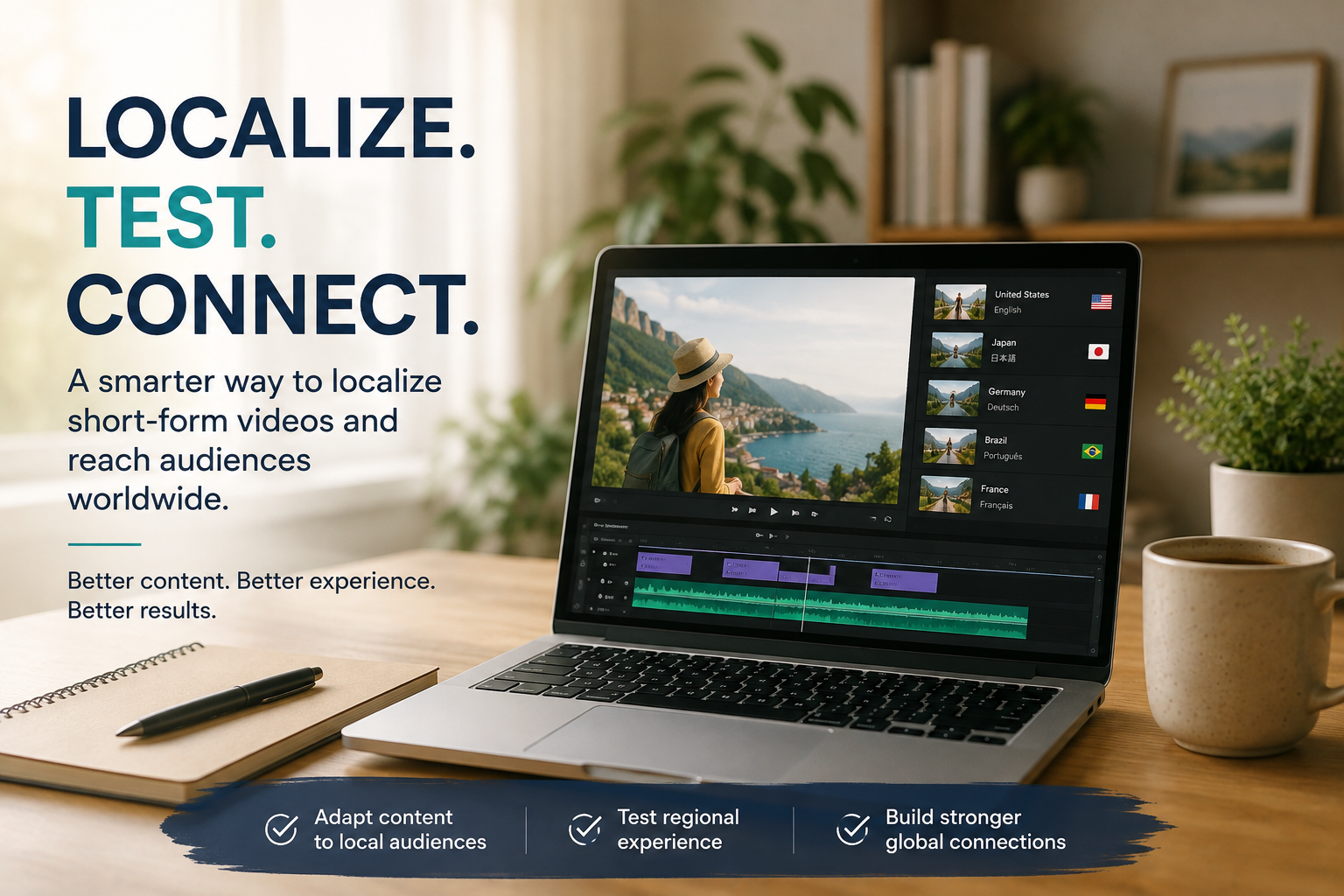
2026 Guide to Localizing Short-Form Video for Global Markets
Learn how to localize short-form videos for international audiences, from content adaptation and multilingual subtitles to regional landing-page testing and real-device reviews. The right proxy infrastructure can also help verify how your content and website appear across different markets.

Short-form video has become one of the most effective ways for brands to reach audiences across borders.
Platforms such as TikTok, YouTube Shorts, and Instagram Reels make it possible for a single piece of content to reach viewers in multiple countries. However, publishing the same video globally does not necessarily mean the content is properly localized.
A video may have accurate subtitles but lead users to the wrong landing page. A product may be available in one market but unavailable in another. Prices, currencies, calls to action, and even page content can change depending on the visitor's location.
This is why successful video localization requires more than translation.
A complete workflow should consider content, language, regional availability, network environment, landing pages, and real-user experience.
In this guide, we will explore how businesses can build a more reliable short-form video localization workflow in 2026 and how proxy infrastructure can support regional experience testing.
1. Start With the Target Market, Not the Video
A common mistake is to create a large number of short videos first and decide where to publish them afterward.
For international marketing, the process should work in the opposite direction.
Before selecting or editing content, define the target market.
For each market, consider:
- Target country or region
- Audience profile
- Local customer needs
- Preferred language
- Currency and pricing
- Product availability
- Local regulations
- Customer support availability
- Relevant landing page
- Preferred call to action
For example, a product tutorial created for US customers may focus heavily on pricing, productivity, and integrations.
The same product introduced to Japanese customers may require different examples, language, tone, and supporting information.
The core product can remain the same, but the way the value is presented should reflect the local audience.
This is why localization should begin with market research rather than translation.
2. Turn Long-Form Content Into Short Videos With a Purpose
Many brands already have a large library of long-form content, including:
- Webinars
- Product demonstrations
- Interviews
- Podcasts
- Tutorials
- Industry presentations
- Customer Q&A sessions
These materials can provide a valuable source of short-form content.
However, simply cutting a 60-minute webinar into ten random clips is unlikely to produce ten useful videos.
A better approach is to identify individual topics that can stand on their own.
For example, a product webinar could potentially become separate videos covering:
- A common industry problem
- A specific product feature
- A customer question
- A practical tutorial
- A comparison between two approaches
- A short industry insight
- A common mistake and how to avoid it
Each clip should provide enough context for someone who has never seen the original video.
Before selecting a clip, ask:
- Can a new viewer understand the topic within a few seconds?
- Does the clip provide a complete takeaway?
- Are the facts and product information still accurate?
- Is the topic relevant to the target market?
- Does the viewer have a clear next step?
This approach creates fewer but more useful localized videos.
3. Localization Is More Than Translating Subtitles
Translation is an important part of localization, but it is only one layer.
A short-form video can contain several different types of information:
Voice → Subtitles → On-screen text → Title → Description → CTA → Landing Page
All of these elements should work together.
For example, imagine an English video promoting a product with the following message:
Save 20% and get started today.
Simply translating the sentence into another language does not complete the localization process.
You also need to check:
- Is the promotion available in that country?
- Is the displayed price correct?
- Is the landing page available in the same language?
- Is the currency appropriate?
- Does the CTA lead to the correct regional page?
- Can local customers actually purchase the product?
Otherwise, users may experience something like:
Localized video → English landing page → USD pricing → unavailable product
Technically, the video has been translated.
From the customer's perspective, however, the experience is not localized.
4. Pay Attention to Language, Formatting, and Visual Layout
Different languages can significantly change the length of subtitles and on-screen text.
A short English sentence may become considerably longer after translation.
This can affect:
- Subtitle line breaks
- Font size
- Video composition
- CTA placement
- Button visibility
- Mobile viewing experience
Before publishing each language version, review:
Language
Check terminology, product names, industry terms, and brand names.
Numbers
Review:
- Prices
- Currency
- Dates
- Measurements
- Phone numbers
- Percentages
Visual elements
Check whether translated text overlaps with:
- Buttons
- Product interfaces
- Important graphics
- Faces
- Logos
- Other subtitles
CTA
Make sure the final call to action matches the actual regional user journey.
Localization should make the entire experience feel natural, rather than simply replacing one language with another.
5. Why Regional Testing Matters
One of the biggest challenges in international content marketing is that websites do not always show identical content to every visitor.
Depending on the website's configuration, users in different locations may receive different:
- Languages
- Prices
- Currency
- Product availability
- Promotions
- Privacy notices
- Redirects
- Content
- Delivery options
This means that testing a website from your office does not necessarily tell you what a user in another country will see.
For example:
US visitor
→ English
→ USD
→ US product page
Japan visitor
→ Japanese
→ JPY
→ Japan-specific product page
If your video is targeting Japanese customers but the CTA sends them to an English US page, the problem may not be visible until someone tests the complete user journey from Japan.
This is where regional proxy testing can become useful.
6. How Proxies Can Support Regional Experience Testing
A proxy can provide a network connection associated with a specific geographic location.
When testing your own website or another resource you are authorized to evaluate, this can help teams observe how location-dependent pages respond to different network environments.
For example, teams can use regional proxy connections to check:
- Whether a localized landing page loads correctly
- Whether the expected currency appears
- Whether regional redirects work
- Whether promotional pages are available
- Whether public content loads properly
- Whether region-specific notices appear
- Whether different markets receive the intended website version
Helodata provides several proxy types designed for different networking requirements, including residential, ISP, mobile, and datacenter proxies.
Its residential proxy network covers 195 countries and 80M+ IPs, with city-level targeting and support for rotating or sticky sessions. This makes residential proxies particularly useful when teams need to conduct location-based testing across multiple markets.
7. Choosing the Right Proxy for the Job
There is no single proxy type that is ideal for every localization workflow.
The right choice depends on what you are testing and whether the same network session needs to be maintained.
Residential Proxies
Residential proxies are a practical option for multi-market testing and location-based research.
They can be useful for:
- Regional landing-page checks
- Market research
- SERP analysis
- Ad verification
- Public content testing
- Location-based website testing
Helodata offers residential IPs across 195 countries, with city-level targeting and flexible session options.
If your team needs to check how a website behaves across multiple countries, residential proxies can provide broad geographic coverage.
ISP Proxies
ISP proxies can be more suitable when you need a consistent network endpoint for repeated testing.
For example:
- Rechecking the same landing page
- Reproducing a previous issue
- Maintaining a consistent session
- Long-running regional monitoring
Helodata's ISP proxy solution provides dedicated IPs across multiple countries and supports persistent sessions.
The key advantage is simple:
A consistent network environment makes troubleshooting easier.
If a localization problem appears today, you can use a similar testing environment again later instead of introducing a completely different network condition.
Mobile Proxies
Mobile proxies can be useful when the project involves mobile-network-related testing.
Helodata offers mobile IPs across hundreds of carriers and supports 4G/5G mobile network environments.
They may help teams investigate:
- Mobile network responses
- Region-dependent content
- Mobile-oriented websites
- Carrier-related behavior
However, mobile proxies should not be treated as a replacement for real mobile devices.
If you need to evaluate:
- Screen size
- Operating system
- GPS
- Device performance
- App behavior
- Weak network conditions
you should still use real devices or a device testing platform.
Datacenter Proxies
Datacenter proxies can be useful for controlled testing environments and basic connectivity checks.
They are often attractive when teams need:
- Fast connections
- Predictable infrastructure
- Cost-efficient testing
- Large-scale technical checks
However, some websites may treat datacenter traffic differently from residential traffic.
Therefore, if your goal is to reproduce the experience of a typical residential visitor, residential proxies may provide a more relevant testing environment.
8. What Proxies Can and Cannot Tell You
It is important not to overestimate what a proxy can do.
A proxy primarily changes the network exit point and IP-based location signal.
It does not automatically turn a test environment into a real local user.
A proxy can help you check:
- Regional page availability
- Location-based redirects
- Currency display
- Public content
- Regional landing pages
- Some location-dependent website behavior
But it cannot independently prove:
- Your video will be recommended to users in that country
- Local audiences will like the content
- The translation is culturally appropriate
- The page works correctly on every device
- A platform will increase your reach
- An account is guaranteed to be safe or stable
Other factors such as account history, language settings, cookies, device characteristics, user behavior, and platform algorithms can influence the final experience.
For this reason, regional proxy testing should be considered one part of the QA process, not a replacement for real-user testing.
9. Build a Repeatable Regional Testing Checklist
Instead of simply reporting:
“The Germany version looks fine.”
create a structured testing record.
A useful checklist could include:
Content ID | Country | Expected Result | Actual Result | Evidence | Status |
|---|---|---|---|---|---|
VIDEO-US-01 | US | English + USD | — | Screenshot | Testing |
VIDEO-JP-01 | Japan | Japanese + JPY | — | Screenshot | Testing |
VIDEO-DE-01 | Germany | German + EUR | — | Screenshot | Testing |
You can also record:
- Testing time
- IP location
- Browser language
- Device type
- Login status
- Cookie status
- Final URL
- Screenshot
- Person responsible
This makes problems much easier to reproduce.
For example, if the Japanese version unexpectedly opens an English landing page, the team can identify exactly which content version, URL, and testing environment caused the issue.
10. Use a Three-Layer Review Before Publishing
A strong localization workflow should include at least three levels of review.
Layer 1: Content Review
Check:
- Translation
- Subtitles
- Voice-over
- Product information
- Pricing
- Brand terminology
- Copyright and content permissions
- Regional product availability
Publicly available content should not automatically be assumed to be available for downloading, editing, translating, or republishing.
Layer 2: Regional Page Review
Within your authorized testing scope, check the target region's:
- Landing page
- Currency
- Pricing
- CTA
- Redirects
- Product availability
- Privacy notices
- Public assets
This is where regional proxy infrastructure can be particularly useful.
Layer 3: Real User Experience
Finally, test the actual experience.
Use:
- Real mobile devices
- Local reviewers
- Native speakers
- Platform previews
Check:
- Subtitle readability
- Video composition
- Page speed
- Mobile layout
- Cultural context
- CTA clarity
A proxy can help reproduce a network location, but it cannot replace a real person evaluating the experience.
11. Start With Two Markets Instead of Ten
If your team is new to international short-form video, there is no need to launch in ten markets simultaneously.
Start small.
For example:
United States + Japan
Take one long-form video and select two or three topics that are genuinely relevant to each market.
Then:
Step 1
Select the most relevant clips.
Step 2
Create English and Japanese versions.
Step 3
Review subtitles, pricing, terminology, and CTA.
Step 4
Test the corresponding landing pages from each target region.
Step 5
Have local reviewers watch the videos on real devices.
Step 6
Publish the versions that pass the review.
Step 7
Analyze performance separately by market.
This makes it easier to identify whether a problem comes from the content, localization, landing page, or user experience.
12. Keep Content Performance and QA Problems Separate
A common mistake is to treat every poor result as a content problem.
For example:
Japanese video has a high bounce rate.
That does not automatically mean Japanese users dislike the video.
The issue could be:
- Slow landing page
- Incorrect language
- Wrong currency
- Broken CTA
- Unavailable product
- Confusing checkout process
For this reason, separate your metrics into different categories.
Content Performance
- Views
- Average watch time
- Completion rate
- Engagement
- Audience retention
User Feedback
- Comments
- Language feedback
- Product questions
- Content-related feedback
Page Performance
- CTA clicks
- Landing-page visits
- Final URL
- Form starts
- Conversion events
QA Issues
- Incorrect language
- Wrong currency
- Broken redirect
- Missing assets
- Subtitle overlap
- Mobile layout problems
This separation helps teams make better decisions.
13. Use Proxies for Testing, Not Artificial Engagement
Regional proxies are useful for legitimate research and quality assurance, but they should not be confused with tools for manufacturing engagement.
There is an important difference between:
Testing how a public page behaves from Germany
and
Trying to make a platform believe that artificial traffic comes from Germany.
A responsible workflow should use proxies for purposes such as:
- Regional website testing
- Market research
- SEO monitoring
- Ad verification
- Public-data research
- Quality assurance
They should not be used to artificially generate:
- Views
- Likes
- Comments
- Clicks
- Conversions
The objective should be to understand the user experience, not manipulate the results.
14. A Practical Workflow for Global Short-Form Video
A scalable localization workflow can look like this:
Market Research
↓
Content Selection
↓
Language & Cultural Adaptation
↓
Video Production
↓
Landing Page Preparation
↓
Regional Network Testing
↓
Real Device Review
↓
Publishing
↓
Performance Analysis
↓
Optimization
In this workflow, proxy infrastructure is only one component.
Its role is to help answer a specific question:
“What does our website or public content look like when accessed from this target market?”
That makes it much more useful than treating a proxy simply as a way to change an IP address.
15. How Helodata Fits Into a Global Content Workflow
For teams working across multiple international markets, Helodata can serve as part of the regional testing and data workflow.
Its proxy portfolio includes:
Residential Proxies
For broad geographic coverage and location-based testing.
ISP Proxies
For more consistent network environments and repeatable testing.
Mobile Proxies
For workflows involving mobile-network-related regional behavior.
Datacenter Proxies
For fast, scalable and cost-efficient infrastructure checks.
Helodata's unified platform also allows teams to manage proxy resources and configurations from a centralized environment.
Instead of building a separate setup for every market, teams can create a standardized testing process and select the proxy type based on the task.
For international marketers, this can make regional QA more structured and easier to scale.
Conclusion
Successful short-form video localization is not simply about translating a video into another language.
It is about making sure the entire user journey feels appropriate for the target market.
That means:
The content is relevant.
The language feels natural.
The visuals work correctly.
The landing page matches the market.
The CTA leads to the right destination.
The experience works on real devices.
Regional proxy testing can support this process by helping teams verify location-dependent website behavior before content reaches a wider audience.
For businesses expanding internationally, the most effective approach is not to localize everything at once. Start with a few important markets, build a repeatable QA process, measure the results, and gradually expand.
The goal is simple:
Don't just make your content understandable worldwide. Make the entire experience feel local.