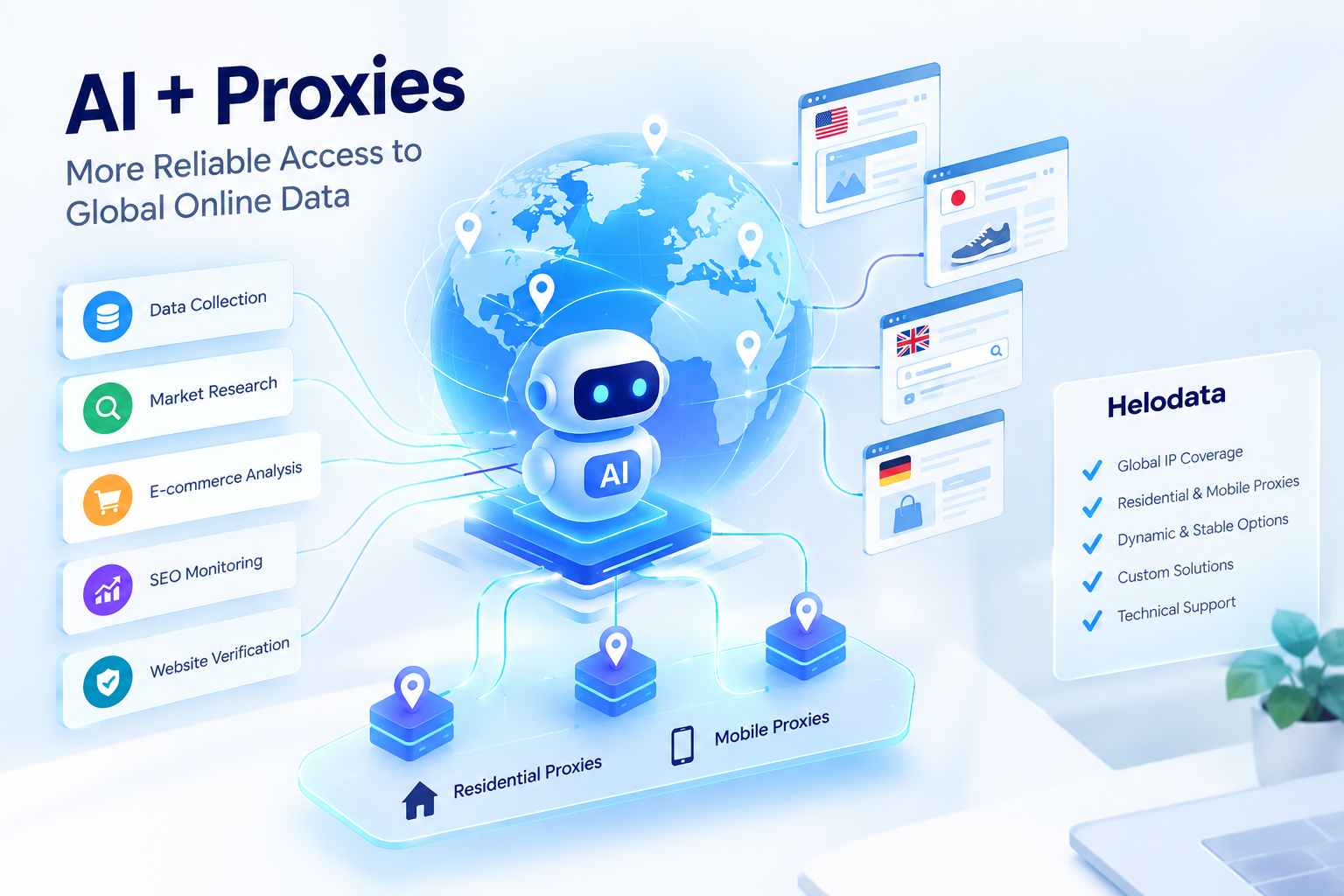
AI Automation and Proxy Networks: Building More Reliable Global Workflows
AI automation depends on more than intelligent models—it also needs reliable access to global online data. Learn how residential and mobile proxies can support AI-powered data collection, market research, e-commerce analysis, SEO monitoring, and regional website verification.

Artificial intelligence is rapidly moving beyond content generation and conversational assistants. Today, businesses are using AI to collect market data, monitor competitors, analyze search results, support e-commerce operations, and automate repetitive online workflows.
However, when an AI-powered workflow needs to interact with websites in different countries or regions, the intelligence of the model is only one part of the equation.
The other part is the network environment.
An AI system may be able to determine what information it needs, but it still needs a reliable way to access that information. IP address, location, connection stability, request patterns, and the type of network being used can all affect the results of automated tasks.
This is where proxy networks can become an important part of an AI automation workflow.
For businesses that need to access global websites and collect location-specific information, Helodata provides residential and mobile proxy solutions that can be selected according to different project requirements.
Why AI Automation Needs a Reliable Network Environment
A typical AI workflow might look simple:
Receive a task → access online resources → collect information → analyze the data → generate a result.
The challenge often appears in the second step.
Suppose an AI system is asked to monitor product prices across several countries. The websites it needs to access may provide different content depending on the visitor's location. Some may also apply traffic controls when they receive a large number of repeated requests from the same IP address.
This can create several problems:
- Data from different regions may not be consistent
- A single IP may generate too many requests
- Some websites may restrict unusual traffic
- Search results can vary by location
- Automated requests may become less reliable over time
- Businesses may need access to multiple geographic markets
A proxy network gives the automation system another layer of flexibility.
Instead of relying on a single network exit, businesses can use proxy IPs from the locations relevant to their projects.
This is particularly useful when the objective is not simply to “access a website,” but to collect information that reflects a specific market or geographic location.
Residential Proxies for AI-Powered Data Collection
One of the most common applications of AI automation is data collection.
AI can process enormous amounts of information, but it still needs reliable data sources.
Businesses may use automated workflows to monitor:
- Product prices
- Competitor websites
- Search engine results
- Market trends
- Customer reviews
- Product availability
- Industry information
- Localized website content
For small-scale projects, a normal connection may be sufficient.
As the number of target websites and requests increases, however, the network layer becomes increasingly important.
Residential proxies use IP addresses associated with residential networks, making them suitable for many business scenarios where a residential network environment is preferred.
With Helodata, businesses can select residential proxy resources based on their project requirements and target locations.
For data-intensive workflows, Helodata's dynamic residential proxy starts from $0.85/GB, providing a flexible option for businesses that need residential IP resources without committing to a fixed IP for every request.
AI-Powered Market Research Across Different Regions
AI is becoming increasingly useful for international market research.
A company entering a new market may want to understand:
- What products are popular locally?
- How much do competitors charge?
- Which brands appear in local search results?
- What products are promoted in a specific country?
- How do local websites present their products?
- Are prices different between markets?
The difficulty is that the internet is not exactly the same everywhere.
A user accessing a website from the United States may see different information from someone accessing the same website from Japan or Germany.
This means that collecting global market data from a single network location can provide an incomplete picture.
Using geographically relevant proxy IPs allows businesses to build data collection workflows around their target markets.
For example:
Japan IP → collect Japanese market data
US IP → collect US market data
UK IP → collect UK market data
The collected information can then be processed by an AI system to identify price differences, product trends, or changes in market behavior.
Helodata's proxy network can therefore serve as the network layer behind these geographically distributed workflows.
E-Commerce: Combining Proxies With AI for Competitive Analysis
E-commerce businesses are another major use case for AI automation.
Online sellers may need to continuously monitor competitors rather than manually checking websites every day.
An automated workflow can collect product information and let AI organize the results into useful insights.
For example:
Collect product pages → extract pricing information → compare competitors → identify changes → generate a report
This workflow can be used for:
- Price monitoring
- Product research
- Competitor analysis
- Stock monitoring
- Market research
- Product trend analysis
However, the information displayed by e-commerce websites may vary depending on location.
A company targeting several markets therefore needs more than just an automated scraper or AI model. It also needs an appropriate network environment for accessing those markets.
Residential proxies can help businesses obtain data from different geographic locations while keeping the network layer separate from the AI processing layer.
With Helodata, businesses can select suitable residential IP resources according to their target markets and data collection requirements.
SEO and Search Result Monitoring
Search engine data is another area where geographic location matters.
The search results for the same keyword can vary between countries, regions, and even different users.
For international SEO teams, monitoring only one location may therefore provide an incomplete view of search performance.
An automated SEO workflow could periodically collect search results from multiple target markets and then use AI to analyze:
- Keyword rankings
- Competitor visibility
- Search result changes
- Local search trends
- Content opportunities
Proxy IPs can provide the geographic layer needed for this process.
For example, an SEO team monitoring several international markets could organize its workflow around different locations rather than collecting everything from a single IP.
This allows the collected data to better reflect the markets being analyzed.
Advertising and Website Verification
AI can also be used to automate website and advertising checks.
For businesses running international campaigns, automated systems may need to verify whether:
- A landing page loads correctly
- Content is available in a target region
- A specific page displays localized information
- Website changes have occurred
- Advertising-related pages are accessible
Again, geographic location can matter.
A website may display different content depending on where the request originates.
Using proxy IPs from the relevant regions allows businesses to perform location-specific checks as part of their automated workflows.
Helodata's residential and mobile proxy resources can be used according to the requirements of these different projects.
Mobile Proxies for Mobile-Centric Workflows
Not every online workflow requires the same type of IP.
Some projects may specifically benefit from mobile network IPs, particularly when the target environment is closely associated with mobile connectivity.
Mobile proxies use IP resources associated with mobile networks and can be considered for use cases such as:
- Mobile-focused market research
- Location-specific data collection
- Advertising verification
- Mobile website testing
- Regional research
- Other projects requiring mobile IP resources
For businesses that specifically need mobile proxy resources, Helodata offers mobile proxies starting from $1.6/GB.
The appropriate proxy type should always be determined by the actual requirements of the project rather than simply choosing the largest IP pool or the cheapest option.
Dynamic or Stable IP? Start With the Workflow
One common mistake when choosing a proxy is focusing only on the number of available IPs.
The more important question is:
What does the automation workflow actually require?
For large-scale data collection, market research, and tasks where IP rotation is useful, dynamic residential proxies can provide greater flexibility.
For workflows that require a more consistent network identity, a stable proxy configuration may be more appropriate.
Different projects can therefore require completely different proxy strategies.
For example:
Business requirement | Possible proxy approach |
|---|---|
Large-scale data collection | Dynamic residential proxies |
Global market research | Residential proxies by target location |
Mobile-oriented research | Mobile proxies |
Long-running workflows | More stable IP configuration |
International SEO monitoring | Residential proxies by region |
Regional website verification | Residential or mobile proxies depending on the target |
There is no universal proxy configuration that works for every AI workflow.
The right choice depends on the target websites, geographic requirements, traffic volume, session behavior, and overall project design.
Why Proxy Quality Matters for AI Automation
AI automation is often designed to run continuously.
A workflow that works for ten minutes but becomes unreliable after several hours is not particularly useful for a business.
This is why proxy quality matters.
For an automated system, businesses generally need to consider:
IP quality
Are the IP resources suitable for the target websites and use case?
Geographic coverage
Can the required countries or regions be accessed?
Connection stability
Can the workflow maintain reliable connections over time?
Scalability
Can the proxy solution support the expected traffic volume?
Flexibility
Can the proxy configuration be adjusted when business requirements change?
Helodata focuses on providing proxy resources for businesses and developers that need global IP access for data collection and other online workflows.
Rather than treating every customer the same, Helodata can also provide customized proxy solutions based on specific project requirements, helping businesses choose a more suitable configuration for their actual use case.
Building a Complete AI Automation Workflow
A reliable AI automation system is not built from the AI model alone.
A practical workflow may contain several layers:
AI Model
Understands the task and analyzes information.
↓
Automation Layer
Executes browser actions, data processing, or other predefined operations.
↓
Network Layer
Connects to external websites and online resources.
↓
Proxy Layer
Provides the required IP type and geographic location.
↓
Target Websites
Provide the data or services required by the workflow.
In this structure, the proxy does not replace the AI system.
Instead, it supports the network side of the workflow.
This separation is important because it allows businesses to adjust their network resources without redesigning the entire AI workflow.
For example, a company may initially operate in two countries and later expand to ten. The AI workflow can remain largely unchanged while the proxy configuration is expanded to support the new markets.
Choosing the Right Proxy for Your AI Project
Before purchasing a proxy solution for an AI automation project, businesses should consider several questions:
1. Which countries or regions do you need?
If the workflow depends on location-specific information, geographic coverage should be one of the first considerations.
2. Do you need residential or mobile IPs?
Residential and mobile proxies serve different purposes. The choice should be based on the actual target environment.
3. How much traffic will the workflow generate?
Traffic volume affects the type of proxy plan that makes sense.
4. Do you need rotating or stable IPs?
Some workflows benefit from IP rotation, while others require a more consistent network identity.
5. Will the workflow scale?
A solution that works for a small test may not necessarily be suitable once the project expands.
For this reason, testing the proxy with the actual workflow before large-scale deployment is often a practical approach.
Helodata: Proxy Infrastructure for Global Online Workflows
AI is changing how businesses collect information and automate online operations.
But intelligent automation still depends on reliable access to the internet.
Whether a business is building an AI-powered market research system, monitoring e-commerce prices, collecting international SEO data, verifying regional websites, or running other location-based workflows, the network environment should be considered part of the overall architecture.
Helodata provides proxy resources designed for businesses and developers that need global IP access.
With residential proxies starting from $0.85/GB and mobile proxies starting from $1.6/GB, businesses can choose different IP resources according to their traffic requirements and use cases.
For projects with more specific requirements, Helodata also supports customized proxy solutions and technical support, helping customers find a configuration that better matches their actual workflow.
The goal is simple:
Let AI handle the intelligence. Let the right proxy network handle the connection.
As AI automation continues to move into real-world business operations, having a flexible and reliable network layer will become increasingly important for organizations working with global data and online services.
Looking for proxy resources for your AI automation project? Explore Helodata and choose a solution based on your actual business requirements.