Amazon Full-Chain Operations Rely on Proxy IPs: Helodata One-Stop Solution for Multi-Account and Data Collection Pain Points
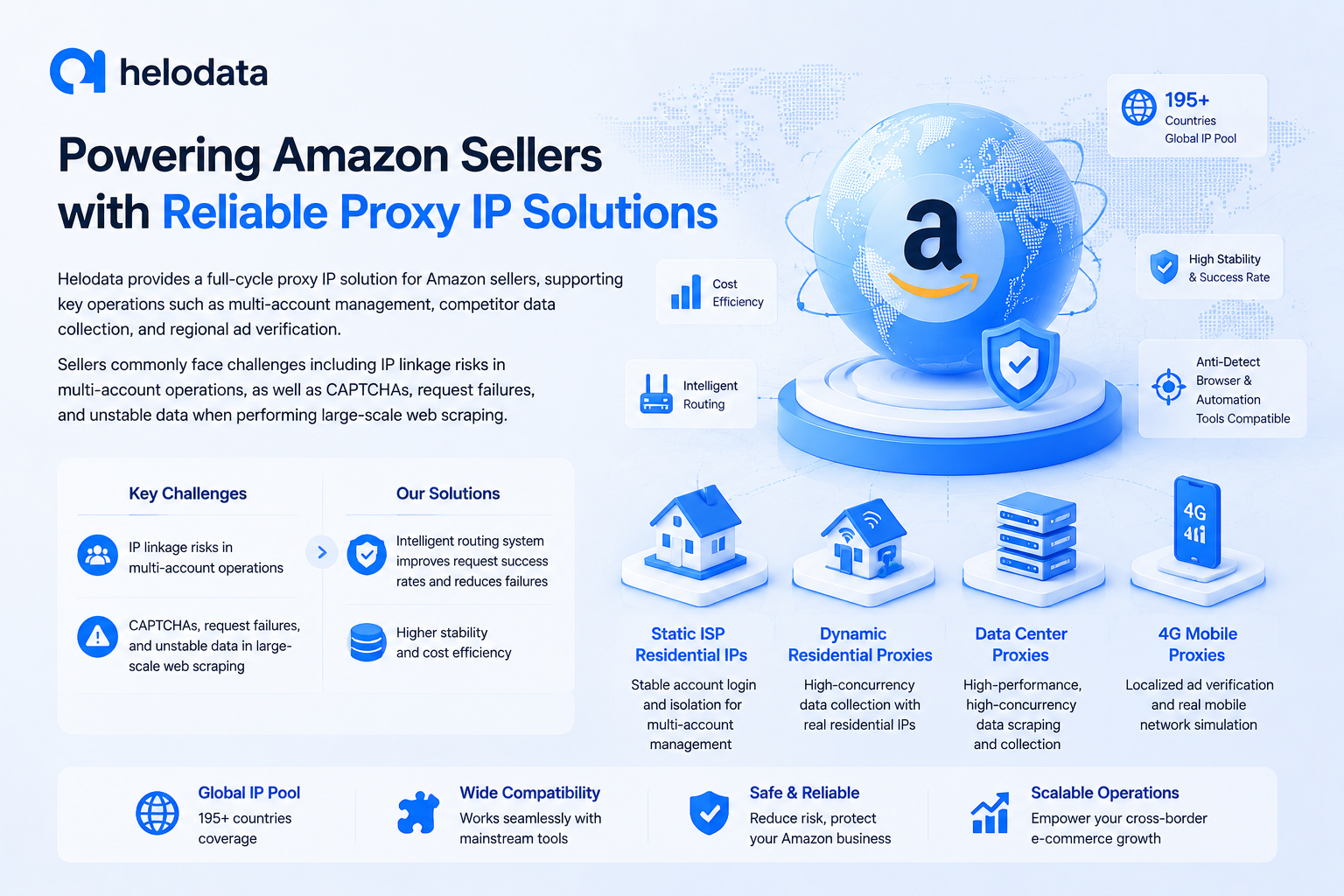
Helodata Amazon Proxy IP Solutions – Overview Helodata provides a one-stop proxy IP solution designed for full-cycle Amazon seller operations, including multi-account management, competitor data collection, and regional ad verification. 1. Key Challenges for Amazon Sellers Amazon sellers commonly face two major issues: Multi-account operations are highly vulnerable to IP linkage and account bans Large-scale data scraping triggers CAPTCHAs, request failures, and unstable crawling results Traditional low-cost proxy services often lead to higher risks, unstable performance, and wasted bandwidth.

Introduction
Almost every Amazon seller faces two critical challenges:
First, multi-store or “store cluster” operations are highly prone to account linkage and bans.
Second, when monitoring competitors or scraping marketplace data at scale, frequent CAPTCHA triggers and request interruptions often occur.
Many sellers simply buy cheap proxy services, only to end up with account restrictions, wasted bandwidth, and ultimately higher overall costs.
This article breaks down the real-world value of proxy IPs in cross-border Amazon operations, and introduces Helodata’s layered proxy solutions designed for the full Amazon workflow, benchmarked against industry leaders like Bright Dataand Oxylabs, balancing stability and cost efficiency.
Four Core Amazon Seller Scenarios That Depend on Professional Proxy IPs
Scenario 1: Multi-store / store cluster operations — IP isolation is the core defense against account linkage
Amazon’s risk control system heavily analyzes IP addresses and network fingerprints to detect account relationships. Logging into multiple stores from the same IP or subnet can lead to reviews or permanent bans.
- New store setup & daily login:
Prefer static ISP residential proxies. These use dedicated home broadband IPs that remain stable over time, perfectly simulating real local users. One store = one independent IP to fully isolate environments, especially when combined with anti-detect browsers. - Short-term product testing & ad browsing:
Dynamic residential proxies are recommended. Large rotating pools of real home IPs significantly reduce detection risk.
Common pitfalls of low-cost shared proxies:
- Shared IP pools with unknown abuse history → high chance of account association risks
- Frequent disconnects and IP switching → abnormal login behavior detected by Amazon system
Scenario 2: Competitor pricing, ranking, and review data collection
Sellers need to continuously scrape competitor pricing, promotions, BSR rankings, and customer reviews for pricing strategy and product research.
- High-frequency requests from a single IP will quickly trigger anti-bot protection.
- High-concurrency monitoring:
Data center proxies are fast and scalable, ideal for 24/7 price tracking at lower cost. - Deep scraping (reviews/product pages):
Dynamic residential proxies with real-user network fingerprints help reduce CAPTCHA triggers.
Low-quality proxy issues:
- Over 50% request failure rates
- High bandwidth waste but low usable data yield
- Data gaps leading to distorted analysis results
Scenario 3: Overseas ad targeting & regional testing
Amazon ads and off-platform marketing campaigns require localized browsing environments to verify:
- Local storefront display
- Ad landing page visibility
- Regional pricing differences
4G mobile proxies offer the highest trust level by mimicking real mobile carrier traffic, making them ideal for ad verification and mobile frontend testing.
Scenario 4: Unified gateway for large-scale operations
For mid-to-large sellers managing dozens or even hundreds of stores:
Instead of multiple physical devices, proxies can act as a unified network gateway. Intelligent routing assigns clean IPs per region automatically, enabling batch operations without triggering risk systems.
Why Amazon Sellers Prefer Helodata Proxy IPs
1.Full proxy portfolio covering all Amazon needs
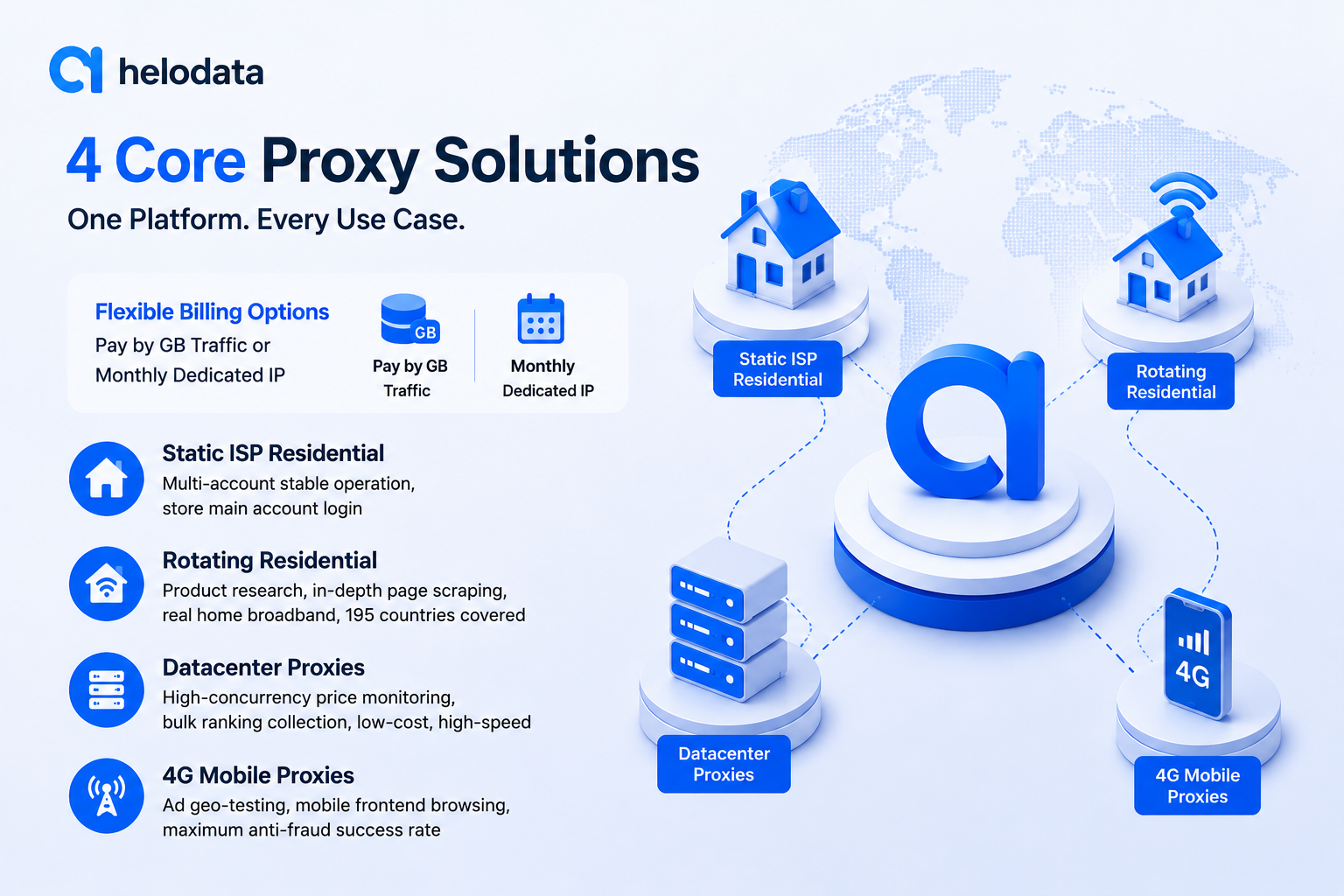
Helodata provides four core proxy types with flexible billing (per GB or dedicated monthly IPs):
- Static ISP residential proxies: long-term account stability
- Dynamic residential proxies: global coverage (195+ countries) for scraping & research
- Data center proxies: high-speed, high-concurrency price monitoring
- 4G mobile proxies: highest trust level for ad testing and mobile browsing
2.High stability with 99.8% request success rate
Powered by a self-developed intelligent routing system, Helodata significantly reduces:
- Connection drops
- Request errors
- Retry loops
Compared to leading providers like Bright Data and Oxylabs, Helodata reduces failed requests and avoids wasted bandwidth, lowering total operational costs over time.
It also provides a clean global IP pool of over 80 million IPs, reducing exposure to previously abused or blacklisted addresses.
3.Strong cost efficiency vs premium competitors
While major providers often price at a premium, Helodata starts from around $0.85/GB.
Plans include:
- Personal
- Developer
- Business
- Enterprise (custom pricing for bulk usage)
Sellers avoid paying for brand markup while maintaining similar operational stability.
4.Easy integration with Amazon tools
Helodata supports standard proxy protocols and comes with full documentation, enabling seamless integration with:
- Anti-detect browsers
- Scraping frameworks
- Price monitoring systems
No major system overhaul required, and technical support is responsive for troubleshooting IP or routing issues.
5.Global coverage across 195+ countries
All major Amazon marketplaces are supported:
- North America
- Europe
- Japan
- Australia
Sellers can match local IPs to each marketplace, ensuring consistent local browsing environments and reducing risk flags.
Proxy Buying Pitfalls Most Sellers Make
- Don’t judge only by price per GB
Low-cost proxies often lead to higher total cost due to failed requests and retries. - Avoid shared proxy pools
Shared abuse history increases account risk dramatically. - Match proxy type to business scenario
Using the wrong proxy type increases detection risk and instability. - Prefer providers with self-built infrastructure
Third-party relay chains often introduce latency and instability.
Compliance Notice
Helodata proxies are intended only for:
- Legitimate overseas public data collection
- Standard Amazon seller operations
We do not provide VPN services for domestic internet bypass.
Users must ensure compliance with all applicable regulations and platform rules. Bulk spam email activities are strictly prohibited.
Conclusion
Whether you are a small seller with 3–5 stores or a large-scale cross-border enterprise managing hundreds of accounts, Helodata’s layered proxy architecture is designed to fit different operational needs.