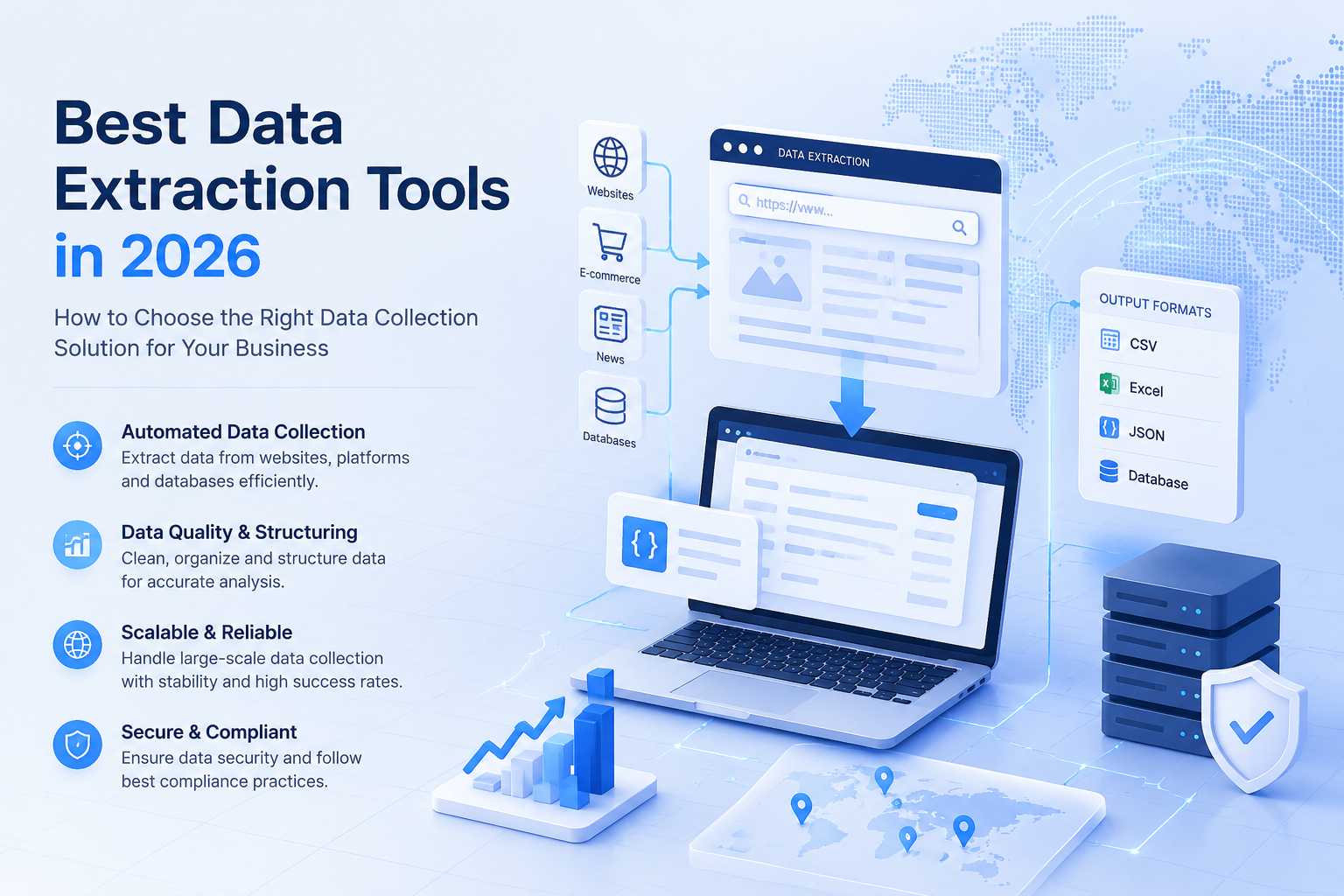
Best Data Extraction Tools in 2026: How to Choose the Right Data Collection Solution for Your Business
Discover the best data extraction tools in 2026 and learn how businesses can automate web data collection, improve data quality, and build reliable data workflows. This guide covers key features, common use cases, and important factors to consider when choosing a scalable data extraction solution for market research, AI, e-commerce, and business intelligence.

In today’s digital economy, data has become one of the most valuable resources for businesses. Whether it is market research, competitor analysis, AI model training, e-commerce monitoring, or advertising intelligence, high-quality data helps companies make faster and more accurate decisions.
However, collecting data manually is becoming increasingly inefficient as websites become more complex and information grows rapidly. Data extraction tools provide an automated way to collect, organize, and process online information, helping businesses improve efficiency while reducing operational costs.
This article explores what data extraction tools are, their key features, common use cases, and how businesses can choose the right solution for their needs.
What Are Data Extraction Tools?
Data extraction tools are software solutions designed to automatically collect information from websites, online platforms, databases, and other digital sources.
Instead of manually copying information, these tools can identify and extract valuable data, then convert it into structured formats such as:
- CSV
- Excel
- JSON
- Database-ready formats
By automating the collection process, data extraction tools help businesses:
- Collect large amounts of information efficiently
- Reduce manual errors
- Maintain continuous data updates
- Improve data analysis workflows
For companies that rely on large-scale information collection, reliable data extraction capabilities have become an essential part of modern digital infrastructure.
Key Features of Data Extraction Tools
Different data extraction solutions provide different capabilities. However, professional-grade tools usually include several important features.
1. Automated Web Data Collection
One of the main functions of data extraction tools is automated website data collection.
They can collect information such as:
- Product details
- Pricing information
- Market trends
- Business information
- Public online content
Automation allows companies to gather large amounts of information without spending significant time on manual research.
2. Data Cleaning and Structuring
Raw web data is often unorganized and difficult to analyze.
Effective extraction solutions can help:
- Remove unnecessary information
- Standardize data formats
- Organize different data fields
- Prepare data for analysis systems
Structured data allows businesses to quickly transform collected information into actionable insights.
3. Large-Scale Data Processing
Enterprise data collection often involves thousands or millions of requests.
A reliable data extraction solution should support:
- High-volume processing
- Automated scheduling
- Stable long-term operation
- Flexible scalability
These capabilities allow businesses to maintain consistent data collection processes.
4. Data Accuracy and Quality Management
The value of data depends not only on quantity but also on quality.
A strong data extraction workflow should focus on:
- Data accuracy
- Data completeness
- Update frequency
- Source reliability
High-quality data helps companies reduce analysis errors and make better business decisions.
Types of Data Extraction Solutions
Depending on business requirements, data extraction tools can generally be divided into several categories.
1. Browser Automation-Based Extraction
Browser automation tools simulate user interactions to collect information from websites.
They are suitable for:
- Dynamic websites
- Interactive pages
- Content requiring user actions
Advantages:
- High flexibility
- Ability to handle complex web structures
Challenges:
- Higher maintenance requirements
- More complex technical management
2. Cloud-Based Data Collection Platforms
Cloud-based solutions provide complete infrastructure for large-scale data collection.
They often include:
- Task management
- Data processing capabilities
- Network resources
- API integration
They are suitable for:
- Enterprise data projects
- Long-term collection tasks
- Global data requirements
3. API-Based Data Access Solutions
Some businesses obtain data through APIs instead of directly extracting information from websites.
Advantages:
- Stable data formats
- Easy integration
- Lower maintenance requirements
However, API solutions may have limitations related to:
- Available data scope
- Request limits
- Usage costs
How to Choose the Right Data Extraction Tool?
Selecting a data extraction solution requires more than comparing prices. Businesses should consider several important factors.
1. Data Collection Scale
Before choosing a solution, companies should evaluate:
- How much data needs to be collected daily?
- Are global data sources required?
- Does the project require continuous operation?
Different data volumes require different technical approaches.
2. Website Complexity
Not all websites are equally easy to extract data from.
Businesses should consider:
- Website structure changes
- Dynamic content loading
- Access restrictions
- Data update frequency
A suitable solution should be able to adapt to different website environments.
3. Reliable Data Access Infrastructure
For global data collection projects, stable network infrastructure is critical.
High-quality proxy networks can help businesses:
- Access localized information
- Improve collection success rates
- Support worldwide data acquisition
Reliable infrastructure ensures smoother and more consistent data operations.
4. Security and Compliance
Businesses should always consider responsible data collection practices.
Important factors include:
- Legal data sources
- Appropriate usage scenarios
- Secure data management
Choosing reliable infrastructure helps organizations reduce operational risks.
Common Applications of Data Extraction Tools
Market Research and Competitor Analysis
Companies use data extraction solutions to:
- Monitor competitor pricing
- Track industry changes
- Analyze market trends
This helps businesses develop more effective strategies.
E-commerce Data Analysis
Online retailers use data extraction tools to:
- Monitor product prices
- Analyze market demand
- Track product availability
This improves operational efficiency and decision-making.
AI Training Data Preparation
Artificial intelligence systems require large amounts of high-quality data.
Data extraction solutions help organizations:
- Collect public information
- Build training datasets
- Improve AI model performance
Advertising and Market Intelligence
Marketing teams use extracted data to:
- Analyze advertising trends
- Monitor market activities
- Understand customer behavior
This supports better campaign optimization.
Future Trends in Data Extraction
As artificial intelligence and automation technologies continue to develop, data extraction solutions are becoming smarter and more efficient.
AI-Powered Data Extraction
Artificial intelligence can help systems:
- Automatically identify webpage structures
- Extract important information intelligently
- Optimize collection processes
Global Data Accessibility
Businesses increasingly need worldwide market information.
Future data extraction systems will rely more on:
- Global network coverage
- Stable connections
- Regional data accessibility
Integration of Data Collection and Analytics
Future solutions will go beyond simple data collection and provide:
- Automated analysis
- Trend prediction
- Intelligent decision support
This will help companies transform raw information into real business value.
Conclusion
Data extraction tools have become an essential solution for modern businesses seeking valuable online information.
When selecting a data extraction solution, companies should evaluate:
- Data volume requirements
- Collection stability
- Data quality
- Network infrastructure
- Compliance considerations
As AI, big data, and global digital markets continue to expand, reliable and efficient data collection capabilities will play an increasingly important role in business success.