Cheap Bright Data Alternatives for Startups: 6 Affordable Proxy Providers in 2026
Bright Data is the industry standard but its $499 monthly minimum, mandatory KYC video call, and $4–8/GB pricing make it the wrong fit for startups and solo developers. The 6 most startup-friendly alternatives in 2026: Helodata — Best overall balance: $2.50/GB, no minimum, self-serve, strong Asia-Pacific coverage Decodo — Cheapest at volume with the easiest dashboard, but bandwidth expires IPRoyal — Lowest per-GB ($1.75) with non-expiring credits, smaller pool Rayobyte — Non-expiring bandwidth, US-focused, slower than top tier Webshare — Cheapest entry point ($1.40/GB on promo) and 10 free proxies forever Proxy-Cheap — Best per-IP rates on static and datacenter IPs

If you've ever priced out Bright Data for a small project, you already know the story. The pay-as-you-go residential rate sits around $4–8/GB. The serious volume discounts don't kick in until the $499/month tier. Before you can even use residential proxies, you have to sit through a KYC video call with a compliance representative. For a Fortune 500 data team with a procurement budget, none of this is a deal-breaker. For a solo developer testing a scraping idea on a weekend, or a pre-seed startup running a $50/month infrastructure budget, it's a hard stop.
This guide is for the second group. We're focused on proxy providers that are genuinely affordable, that let you start small, and that don't require a sales call before you can write your first line of code. No enterprise procurement workflows, no minimum monthly spend, no surprise commitments. Just providers you can sign up for in five minutes and pay for what you actually use.
The six options below all met three baseline criteria: meaningful self-service onboarding, transparent pricing on the website, and a real way to start using the service for under $30 (or free).
What Makes a Proxy Provider "Startup-Friendly"?
Cheap per-GB pricing is the headline metric, but it's not the whole picture. A provider can advertise $1/GB and still be the wrong fit if you have to commit $300 up front to access it. Here's what actually matters when you're operating with a tight budget.
No minimum monthly commitment. The single biggest gatekeeping mechanism in this category is the monthly floor. Bright Data's $499/month commitment is the most famous example, but several mid-market providers have softer versions of the same thing — minimum $90 plans, minimum 25 GB packages, or PAYG rates so high they push you toward subscriptions.
Real pay-as-you-go pricing. A provider that offers PAYG at 3× the subscription rate is technically pay-as-you-go, but it's a trap for small users. Genuine PAYG means a rate that's reasonable at low volumes, with credits that ideally don't expire.
Free trial or money-back guarantee. You shouldn't have to commit money to find out whether a provider works on your target sites. The best providers offer a small free allocation (Webshare's 10 free proxies forever, Decodo's 100 MB / 3 days) or a money-back window long enough to actually test.
Self-serve sign-up. Credentials within minutes of registration. No sales call. No mandatory KYC video for residential access at small volumes. The friction of a video verification with a compliance team is fine for a $10K/month enterprise account; it's absurd for someone testing a $20 use case.
Transparent pricing on the website. If you have to email sales to find out what something costs, the answer is "more than you want to pay." Providers that publish their full pricing publicly are signaling that they're built for self-service buyers.
Docs and SDKs that respect solo developers. Clear getting-started guides, working code examples in the major languages (Python, Node.js, Go, cURL), and a dashboard that surfaces real-time usage without three layers of menus.
The 6 Best Affordable Bright Data Alternatives for Startups
1. Helodata — Best Overall Balance of Price, Quality, and Startup Friendliness
Best for: Startups and solo developers who want production-grade infrastructure without the enterprise pricing model.
Helodata is built around the exact gap Bright Data leaves open: a real product with real performance, but priced and packaged for teams that aren't running a procurement department. Residential proxies start at $2.50/GB with no minimum monthly commitment, no KYC video call for self-service plans, and credentials available within minutes of sign-up.
Starter cost: $0 to sign up; pay only for what you use. PAYG starts at $2.50/GB residential. You can validate the full platform on a free trial before committing any money.
IP pool and coverage: 80M+ residential IPs, 1.3M+ static ISP, mobile and datacenter networks, 195 countries. Asia-Pacific coverage — Southeast Asia, Japan, South Korea, Taiwan, Hong Kong, Singapore — is unusually deep for a provider at this price tier.
Pricing: Residential from $2.50/GB. Static ISP from $3.00/IP. Dedicated ISP from $0.50/IP. Mobile from $5.00/GB. Unlimited residential plans for high-volume scraping. Pay-as-you-go is the default — no subscription required, no monthly minimum.
Pros: Genuine self-service onboarding with no sales call required. Standard HTTP/SOCKS5 protocols, which makes migration from any other provider a one-line credential swap. Native integrations with developer tools the startup crowd actually uses — LangChain, LlamaIndex, n8n, Scrapy, Playwright, Puppeteer. Real-time dashboard with per-request logs. 99.7% success rate, 99.9% uptime SLA. Strong Asia-Pacific coverage for teams targeting regional markets.
Cons: Smaller residential IP pool than enterprise giants (80M+ vs 175M+ at Oxylabs) — not a problem for most startup workloads, but worth knowing if you need ultra-broad geographic targeting. Brand awareness in Western enterprise circles is lower than the legacy providers.
Verdict: If you want one provider that scales from your first $10 test request to a production scraping pipeline without forcing you onto enterprise contracts, Helodata is the strongest fit. The $2.50/GB rate isn't the absolute cheapest on this list, but the combination of price, quality, and no-commitment access is the best balance for serious startup workloads.
2. Decodo (formerly Smartproxy) — The Cheapest at Volume, Easiest Onboarding
Best for: Startups that expect to scale past 50 GB/month and want the smoothest dashboard experience in the category.
Smartproxy rebranded to Decodo in 2025. The product remains one of the most cost-efficient residential proxy networks at moderate-to-high volumes, with independent pricing analysis consistently placing Decodo at the top of the GB-per-dollar leaderboard.
Starter cost: Free trial of 100 MB over 3 days. Smallest paid residential plan is around $7 for 1 GB. Pay-as-you-go available without subscription.
IP pool and coverage: 115M+ residential IPs, 195+ countries, full country/state/city/ZIP/ASN targeting.
Pricing: Residential subscriptions start at $7/GB at the smallest tier, dropping to $2/GB at the highest volume tier. Pay-as-you-go is $8.50/GB billed from a wallet balance. 14-day money-back guarantee on most paid plans.
Pros: 99.86% published success rate. The dashboard is consistently rated the easiest to onboard onto in the residential category — Decodo has won Proxyway's "fastest time to value" award for several consecutive years. Strong documentation, working code samples, and a Chrome extension for casual testing.
Cons: Bandwidth on monthly subscriptions expires at the end of the billing cycle, which penalizes bursty usage. The PAYG rate of $8.50/GB is intentionally high to push users toward subscriptions — not ideal for small one-off projects. The 100 MB free trial is genuinely small.
Verdict: If you're confident you'll consistently hit 20+ GB/month, Decodo's subscription pricing is among the best in the market. For unpredictable workloads where bandwidth might go unused, the expiring credits work against you.
3. IPRoyal — Lowest Sustained Per-GB Rate With Non-Expiring Credits
Best for: Indie hackers and freelancers with irregular workloads who hate losing unused bandwidth.
IPRoyal pairs one of the lowest per-GB rates on the market with the genuinely valuable feature of credits that never expire. For projects that run in bursts — monthly SEO audits, quarterly competitive research, occasional scraping jobs — this combination is hard to beat.
Starter cost: No minimum. You can buy as little as 1 GB at the $1.75/GB rate and use it whenever you want, no expiration.
IP pool and coverage: 34M+ residential IPs across 195+ countries, with country and city targeting. Strong datacenter and ISP offerings.
Pricing: Residential from $1.75/GB. Static ISP proxies from $2.70/IP/month. Dedicated datacenter from $1.39/IP. Non-expiring credits across all PAYG residential purchases.
Pros: Lowest sustained per-GB rate among credible mid-tier providers. Non-expiring bandwidth removes the "use it or lose it" pressure of monthly subscriptions. SOCKS5 supported on most products. Clean dashboard, straightforward docs. Payment methods include credit card, PayPal, and crypto.
Cons: The pool is genuinely smaller — at 34M+, IPRoyal is about a fifth the size of Oxylabs' network. On heavily protected targets (Cloudflare, Datadome), success rates lag the premium providers. Customer support is functional but not always fast. City-level targeting precision is more limited than at SOAX or Bright Data.
Verdict: If your monthly spend is under $100 and you only need adequate-quality residential IPs for standard scraping tasks, IPRoyal is one of the cheapest legitimate options available. The non-expiring credits make it especially good for projects with bursty traffic patterns.
4. Rayobyte — Ethical Sourcing With Non-Expiring Bandwidth, US-Focused
Best for: US-focused startups that value ethical IP sourcing and predictable, non-expiring bandwidth.
Rayobyte (formerly Blazing SEO) is a US-based provider with strong ethics-first positioning. The standout feature is non-expiring bandwidth: buy 10 GB once, use it across six months if you want, no pressure to consume before a deadline.
Starter cost: 2-day free trial with 50 MB. Smallest paid residential plan starts at $3.50 for 1 GB with non-expiring credits.
IP pool and coverage: 40M+ residential IPs across 163+ locations, 300,000+ datacenter IPs in 20,000+ C-class subnets. US coverage is among the deepest available; international coverage thins out outside the US and EU.
Pricing: Residential at a flat $3.50/GB across the 1–49 GB range, which makes small purchases predictable. Volume pricing drops aggressively at multi-TB scale, reaching $0.50–$0.90/GB. Datacenter and ISP products available separately.
Pros: Non-expiring bandwidth is one of the most pro-customer features in the proxy market. Ethical sourcing model is audited and documented. Strong US datacenter and ISP coverage. Automatic IP replacement when an IP gets flagged. Predictable flat pricing in the small-volume range.
Cons: Independent benchmark testing has historically shown Rayobyte's residential proxies to be slower than top-tier alternatives — sometimes by 2-3x on the same target. International coverage outside the US and EU is thin. No SOCKS5 support on some products. No UDP. The dashboard could use modernization.
Verdict: Choose Rayobyte if your scraping workloads are US-focused, your volumes are irregular, and the non-expiring credits matter more than raw speed. For latency-sensitive workloads or heavily international targets, the providers above are better.
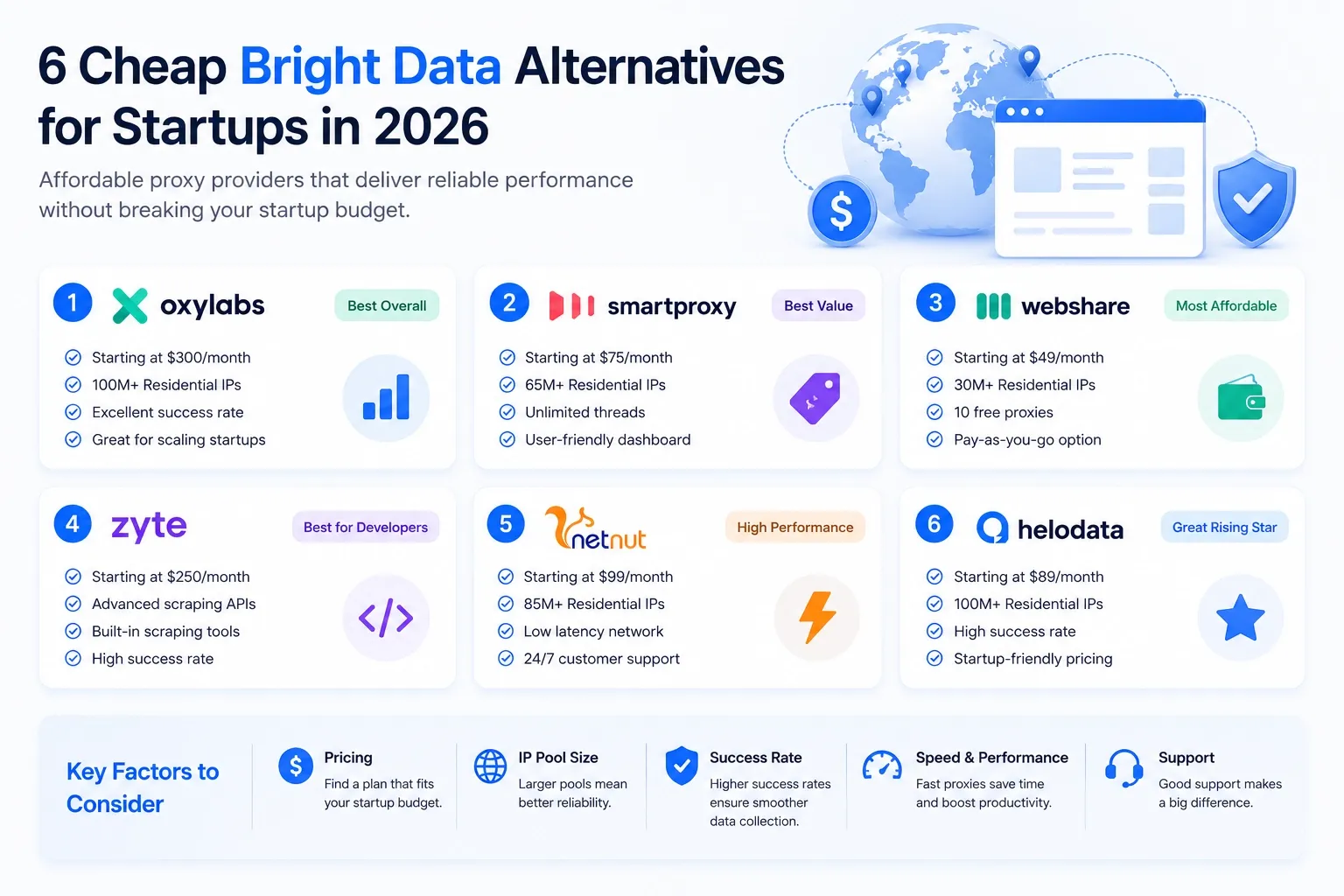
5. Webshare — Cheapest Entry Point With a Genuinely Useful Free Tier
Best for: Solo developers and budget-constrained projects that need to test before paying anything.
Webshare is the price floor of the credible residential proxy market. The provider was acquired by Oxylabs but still operates as its own brand, offering a self-service product designed for developers and small teams. The free tier — 10 datacenter proxies and 1 GB/month, no credit card, no expiration — is one of the only genuine "free forever" offerings in the proxy space.
Starter cost: $0. The free tier is permanent. Paid datacenter plans start at $2.99/month for 100 proxies. Rotating residential currently runs at $1.40/GB on a 50% off promotion (regular rate $2.80/GB), though promo terms shift; verify the current rate before relying on it.
IP pool and coverage: 80M+ rotating residential IPs across 195 countries. 500K+ datacenter and ISP IPs. Geo-targeting at the country level for residential; city targeting on higher tiers.
Pricing: Free plan (10 proxies, 1 GB/month, permanent). Datacenter from $2.99/month. Rotating residential from $1.40/GB on current promo (normally $2.80). Static residential from $0.30/IP. Yearly billing saves another ~30%.
Pros: Free tier is real and useful — same 99.97% uptime infrastructure as paid plans. Cheapest residential entry point among credible providers when the promo is active. HTTP and SOCKS5 on all proxy types. Clean modern dashboard. Stripe, Apple Pay, Google Pay supported. Active Chrome extension for casual users.
Cons: Honest assessment: shared datacenter proxies can get rate-limited when many users target the same site. The residential pool is described by Webshare itself as "heavily shared" at the free tier. Success rates on heavily protected targets lag the premium providers. The 48-hour refund window with a 0.1 GB residential cap is genuinely tight if you want to fully test. Support is email-only — no live chat. City-level targeting requires higher tiers.
Verdict: Webshare is the right pick when budget is the dominant constraint and your targets aren't aggressively defended. Start with the free 10 proxies, validate the use case, then scale up only if it works. For more demanding targets, plan to upgrade to a higher-quality provider.
6. Proxy-Cheap — Specialty Pricing on Static and Datacenter IPs
Best for: Startups that primarily need static residential or datacenter IPs at the lowest possible per-IP rate.
Proxy-Cheap lives up to the name on specific product lines — particularly static residential and datacenter IPv4/IPv6. The rotating residential offering exists but isn't as competitive as the specialty products. For startups whose workloads fit the static IP model, the per-IP economics are hard to match.
Starter cost: No minimum. Static residential IPs available from $1.27/IP. Datacenter IPv4 from $1.18/IP. Datacenter IPv6 from $0.20/IP. Crypto and credit card payments accepted.
IP pool and coverage: Network spans residential, datacenter, mobile, IPv4, and IPv6 products. Coverage across 100+ countries, with the static residential network growing steadily. Specific country/city availability varies by product.
Pricing: Static residential from $1.27/IP. Datacenter IPv4 from $1.18/IP. Datacenter IPv6 from $0.20/IP. Static mobile from $11.61/IP. Rotating residential and rotating mobile available; pricing varies.
Pros: Among the lowest per-IP rates on the market for static products. Wide range of IP types under one account — useful for teams that need datacenter for one workflow and static residential for another. Chrome and Firefox extensions for casual switching. Multiple payment methods including crypto. Referral program offers up to 25% commission.
Cons: Rotating residential per-GB pricing is less competitive than IPRoyal or Webshare for that specific product. Pool size and quality are not at the same tier as premium providers — fine for standard tasks, less reliable on heavily protected targets. Documentation is functional but thinner than at Decodo or Helodata. International coverage is uneven.
Verdict: Proxy-Cheap is a specialty pick. If you need a stack of static residential or datacenter IPs at the lowest per-IP cost, it's a strong fit. For rotating residential as your primary workflow, look elsewhere on this list first.
Pricing Comparison for Startups
How much does each provider actually cost at the volumes a startup typically buys?
Provider | 1 GB Cost | 5 GB Cost | 20 GB Cost | Min Commitment | Free Trial | Payment Methods |
|---|---|---|---|---|---|---|
Helodata | $2.50 | $12.50 | $50.00 | None | Yes (self-serve) | Card, PayPal |
Decodo | $7.00 (sub) / $8.50 (PAYG) | $35 / $42.50 | $90 / $170 | None (PAYG) | 100 MB / 3 days | Card, PayPal, crypto |
IPRoyal | $1.75 | $8.75 | $35.00 | None | Yes | Card, PayPal, crypto |
Rayobyte | $3.50 | $17.50 | $70.00 | None | 2 days / 50 MB | Card, PayPal |
Webshare | $1.40 (promo) | $7.00 | $28.00 | None | Free 1 GB forever | Card, Apple Pay, Google Pay |
Proxy-Cheap | Varies* | Varies* | Varies* | None | Limited | Card, PayPal, crypto |
*Proxy-Cheap's strongest pricing is on static IPs ($1.27/IP) and datacenter IPs ($1.18/IP) rather than per-GB residential.
Pricing reflects current published rates as of mid-2026. Promotional rates change frequently; confirm on each provider's site before purchase. Subscription pricing assumes you fully consume the bandwidth in the billing period.
Hidden Costs to Watch Out For
The advertised per-GB rate is the start of the conversation, not the end. Here are the line items that catch startups off guard.
Failed requests billing. Several providers, including Bright Data and some scraping API products, bill you for failed requests — including CAPTCHAs and anti-bot blocks that never returned data. On a heavily protected target site where 30% of requests fail, this can effectively raise your per-successful-request cost by 40%. Verify each provider's policy explicitly: do they bill for failures, or only for successful responses? Helodata, Decodo, IPRoyal, and Webshare all bill on successful bandwidth only. Some scraping API products from any vendor handle this differently.
Bandwidth overage rates. If you exceed your monthly allocation on a subscription plan, overage rates are often 2-3x the base per-GB rate. The pattern: you signed up for $75/month with 25 GB included. You use 30 GB. The extra 5 GB bills at $5/GB instead of $3/GB. Budget assuming you'll go over, or pick non-expiring PAYG.
Static IP renewal costs. Static residential and dedicated ISP IPs are typically priced per IP per month. If you buy 10 IPs at $3/IP, that's $30/month — recurring. Some providers automatically rotate flagged IPs at no charge; others charge for replacements. Read the small print.
Premium IP and city targeting upcharges. Standard country-level targeting is usually included in the base rate. State, city, and ASN targeting are often charged at premium rates — sometimes 50% over the base per-GB. SOAX and Helodata include granular targeting at no upcharge on most plans. Bright Data and Oxylabs charge for it on certain tiers.
KYC and compliance delays as a hidden time cost. For providers that require KYC for residential access, the verification process can take 24–72 hours. If your project has a deadline, that's a real cost. The self-service providers (Helodata, Webshare, IPRoyal) avoid this for self-service plans — Helodata's KYC policy only kicks in for enterprise or high-volume accounts where it's genuinely necessary.
Quick Recommendation by Use Case
Solo developer scraping Amazon product data: Decodo or Helodata. Both handle Amazon's anti-bot stack reasonably well, both offer self-service onboarding, and both have transparent PAYG pricing. Start with Decodo's 100 MB free trial; if you need ongoing flexibility without expiring credits, switch to Helodata for e-commerce scraping.
Pre-seed startup building a price monitoring product: Helodata. The combination of $2.50/GB residential, $0.50/IP dedicated ISP for stable monitoring sessions, no minimum commitment, and developer-friendly integrations (n8n, LangChain, Scrapy) maps directly onto an early-stage product roadmap. You can launch with $20 of credits and scale to thousands of GB without renegotiating anything. See Helodata's e-commerce intelligence use case for typical configurations.
Indie hacker doing SEO rank tracking: Webshare's residential proxies on the current $1.40/GB promo, or Decodo if you need more reliable city-level targeting. For SEO rank tracking use cases, country and city targeting matter more than aggressive anti-bot capability — both providers handle SERP rank tracking well at low cost. The Webshare free tier is enough to validate your pipeline before paying.
Solo dev building an AI scraper / RAG pipeline: Helodata. The native LangChain and LlamaIndex integrations remove a meaningful chunk of integration work, and the success rate on Cloudflare-protected sites is published at 99.4%, which matters when you're feeding clean data into a vector DB. Helodata's bulk data collection and crawler use cases cover the typical AI-data workflow.
Researcher running occasional scraping jobs: IPRoyal or Rayobyte. Both offer non-expiring credits, both are cheap, and both work for adequately protected research targets. IPRoyal wins on per-GB cost ($1.75 vs $3.50); Rayobyte wins on US-specific reliability. For market research workloads needing better coverage, Helodata is the next step up.
Startup needing a stack of static residential IPs for multi-account management: Proxy-Cheap or Helodata. Proxy-Cheap has the lowest static residential per-IP cost; Helodata's dedicated ISP at $0.50/IP is competitive and pairs well with the social media management use case for teams running multi-account workflows.
Frequently Asked Questions
What's the cheapest residential proxy provider in 2026?
For credible providers with usable infrastructure, Webshare on its current promotion ($1.40/GB) and IPRoyal ($1.75/GB) tie for the lowest sustainable per-GB rate. Below that price point, you start sacrificing pool quality, success rates, and support meaningfully. Helodata at $2.50/GB sits in the next tier and offers a stronger balance of price and reliability for serious workloads.
Can I really use proxies for free?
Yes, within limits. Webshare offers 10 datacenter proxies with 1 GB/month permanently with no credit card. Decodo, Helodata, and others offer time-limited free trials. None of these are sufficient for production workloads, but all are enough to validate whether the provider works on your target sites before you pay anything.
Do I need to commit to a monthly subscription?
No. Helodata, IPRoyal, Rayobyte, Webshare, and Proxy-Cheap all offer no-commitment pay-as-you-go pricing. Decodo offers PAYG but at a higher per-GB rate than its subscription plans. Bright Data, Oxylabs, and NetNut typically push users toward monthly commitments for their best rates.
Will cheap proxies work on Cloudflare-protected sites?
Sometimes, but with lower success rates than premium providers. Webshare and IPRoyal will get you 60–80% success on heavily protected Cloudflare targets in our testing. Decodo and Helodata typically achieve 95%+ on the same targets. If your target site is on Cloudflare's most aggressive tier or uses Datadome, plan to either pay more per GB or accept retries as a cost of business.
Is it safe to use cheap proxies for legitimate scraping?
Yes, as long as the provider sources its IPs ethically. All providers on this list publish their sourcing models. Webshare, Helodata, Decodo, and Rayobyte have detailed compliance and IP-sourcing documentation. Avoid providers that won't tell you where their IPs come from — those tend to be the ones with shared botnet infrastructure that can taint your project.
Can I pay with cryptocurrency or PayPal?
Yes, depending on the provider. IPRoyal, Decodo, and Proxy-Cheap all accept crypto. Most also accept PayPal. Webshare uses Stripe and supports Apple Pay and Google Pay. Helodata supports standard card and PayPal. If crypto is a hard requirement, IPRoyal and Proxy-Cheap are the most flexible.
Conclusion
Cheap doesn't have to mean unreliable. The market in 2026 offers genuinely capable residential proxy infrastructure at price points that wouldn't have been possible three years ago. The right choice depends on what you're optimizing for:
- Best overall balance for serious startups → Helodata
- Cheapest at moderate volume with the best dashboard → Decodo
- Lowest per-GB with non-expiring credits → IPRoyal
- Non-expiring + US-focused → Rayobyte
- Cheapest entry point with a free tier → Webshare
- Cheapest static IPs → Proxy-Cheap
Start with whichever provider offers a free trial or genuine PAYG that matches your workload, validate against your actual target sites, and scale only when the unit economics work.
Ready to build on a proxy stack designed for startups? Helodata gives you 80M+ residential IPs across 195 countries at $2.50/GB, with no minimum commitment, no KYC video call, and self-service onboarding in under five minutes. See residential pricing →