Data Retrieval Explained: Methods, Technologies, and Best Practices for Modern Businesses
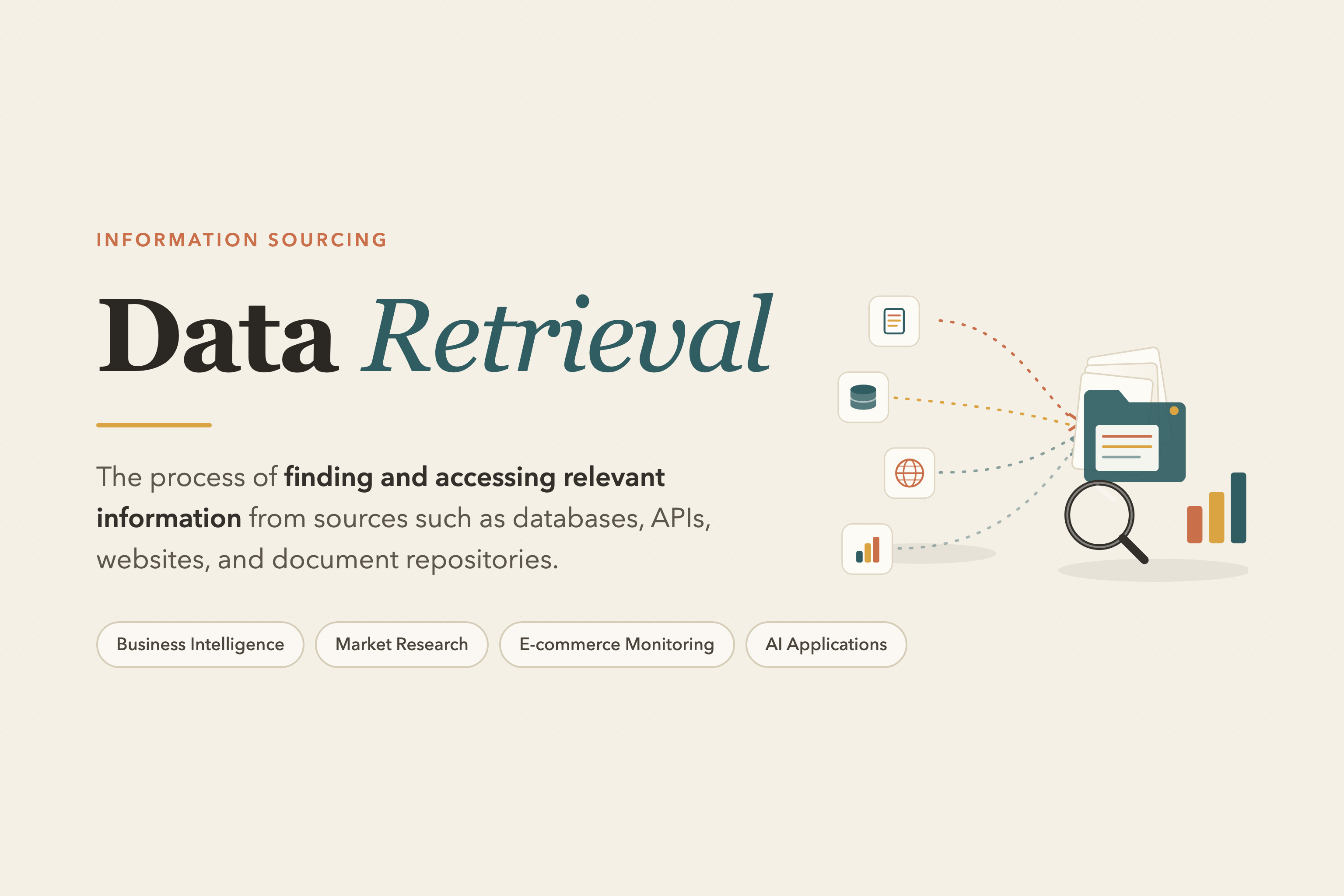
Data retrieval is the process of finding and accessing relevant information from sources such as databases, APIs, websites, and document repositories. It plays a critical role in business intelligence, market research, e-commerce monitoring, and AI applications.

Introduction
Data has become one of the most valuable resources for modern businesses. From monitoring competitor prices and researching new markets to powering AI applications and improving customer experiences, organizations increasingly rely on timely and accurate information to make informed decisions.
However, collecting information is only one part of the process. Businesses must also be able to locate the right data, access it efficiently, organize it into a usable format, and deliver it to the systems that need it. This is where data retrieval becomes essential.
As digital information continues to grow in volume and complexity, traditional search methods alone may no longer be sufficient for every use case. Modern data retrieval combines database queries, APIs, search technologies, automated web data collection, and increasingly, AI-powered tools.
In this guide, we will explain what data retrieval means, explore the main retrieval methods, examine how businesses use them, and discuss the technical considerations that help organizations build more reliable data workflows.
1. What Is Data Retrieval?
Data retrieval is the process of locating and accessing specific information from a data source in response to a request. The source may be a relational database, a cloud storage system, a document repository, an API, or a publicly accessible website.
The goal is not simply to obtain a large volume of information. Instead, an effective retrieval process identifies relevant records and makes them available in a format that can be used for analysis, reporting, automation, or decision-making.
For example, an e-commerce company may need to retrieve product prices from multiple online retailers. A marketing team may search a customer relationship management system for particular account records. An AI application may retrieve relevant documents from a knowledge base before generating an answer.
Although these tasks involve different technologies, they share the same basic principle: a request is sent to a source, relevant information is identified, and the results are returned to the requesting application.
Data Retrieval vs. Data Collection vs. Data Extraction
These terms are closely related, but they describe different aspects of working with information.
- Data retrieval focuses on finding and accessing the information required for a particular task.
- Data collection refers to gathering information from one or more sources, often over time.
- Data extraction involves obtaining data from a source and transferring it into a format or environment where it can be processed.
Consider a business that monitors product prices across several online stores. Collecting information means gathering product listings over time. Retrieving data means locating the products and prices relevant to a specific comparison. Extracting data means pulling those values from source pages or an API into a structured dataset.
In practice, these activities often form a connected workflow. Their boundaries may overlap depending on the technology and business objective.
2. Why Does Data Retrieval Matter?
The value of data depends largely on whether people and systems can access it when they need it. Even a comprehensive dataset offers limited practical value if the information is outdated, difficult to locate, or expensive to process.
Efficient data retrieval supports several important business objectives.
Faster and Better Decision-Making
Businesses frequently need information to evaluate market conditions, identify opportunities, and respond to changes. Efficient retrieval makes it easier to access relevant information without manually searching through large amounts of records.
For example, a retail team can compare product prices across different marketplaces, while an analyst can retrieve historical sales figures to identify changes in customer demand.
More Efficient Data Workflows
Manual information gathering can consume considerable time, especially when the same task must be repeated across many sources.
Automated retrieval allows businesses to schedule queries, collect permitted information, and transfer results into reporting or analytics systems. This reduces repetitive work and helps teams focus on interpreting results rather than gathering them manually.
More Relevant Search Results
A system that returns thousands of unrelated records is not necessarily useful. Effective retrieval must consider relevance, accuracy, and the specific requirements of the requesting application.
Indexing, filtering, ranking, and metadata management help narrow down large datasets and make the results more useful.
Better Support for Automation and AI
Modern applications increasingly rely on external or internal information to complete tasks. Search engines, recommendation systems, business intelligence platforms, and AI assistants all depend on retrieving relevant information from appropriate sources.
For AI systems in particular, retrieval can provide supporting documents or factual context before a model generates a response. This approach can improve the relevance of answers, although the final result still depends on source quality, retrieval accuracy, and how the model uses the information.
3. How Does the Data Retrieval Process Work?
The exact process depends on the data source and the technology being used. Nevertheless, most retrieval workflows include several common stages.
Step 1: Define the Information Requirement
Before selecting a tool, determine what information is needed and how it will be used.
A project might require product names, prices, availability, and product URLs. Another might need company information, public search results, or records from an internal database.
Clearly defining the required fields helps prevent unnecessary collection and makes it easier to evaluate whether the final results are complete.
Step 2: Identify the Appropriate Data Source
The next step is to locate a source that provides the required information.
Depending on the project, this may be an official API, a database, a public dataset, a document repository, or a website. When an authorized API provides the necessary information, it is often a practical starting point because it offers a defined interface and structured responses.
If the required information is available only through web pages, automated web data collection may be another option, subject to the website's terms, access controls, and applicable laws.
Step 3: Send a Query or Request
Once the source has been identified, the system submits a request. A database application may use SQL, while an API-based workflow sends an HTTP request to a defined endpoint.
For website-based retrieval, a program may request a page and parse its HTML. If the page relies heavily on client-side JavaScript, browser automation or another rendering method may be necessary to access the information that appears after the page loads.
The request method should match the structure and accessibility of the source.
Step 4: Retrieve and Validate the Results
After the request is processed, the system receives the relevant records or page content. The returned information should then be checked for completeness, consistency, and accuracy.
For example, a price-monitoring workflow should identify missing prices, unexpected formats, duplicate products, and values that may have changed since the previous collection cycle.
Validation is particularly important when the retrieved information feeds into automated business decisions.
Step 5: Transform and Store the Data
Raw results are not always ready for immediate use. They may need to be converted into a standardized structure, cleaned, deduplicated, or enriched with additional fields.
The processed information can then be stored in a database, spreadsheet, data warehouse, or other suitable destination. Depending on the workflow, the next step may involve reporting, visualization, machine learning, or further automated processing.
Step 6: Monitor and Improve the Workflow
Data sources change over time. Websites redesign their layouts, APIs introduce new versions, and database structures evolve. Retrieval systems therefore require ongoing monitoring.
Tracking response times, failed requests, missing fields, and data freshness helps teams identify problems before they significantly affect downstream processes.
4. Common Data Retrieval Methods
There is no single retrieval method that works best for every project. The appropriate choice depends on the source, data structure, access permissions, volume, and required update frequency.
4.1 Database Queries
Database querying is one of the most established forms of data retrieval.
Relational databases such as PostgreSQL and MySQL store information in structured tables. SQL allows applications to retrieve specific records, filter results, combine related tables, and perform calculations.
For instance, a sales platform might query transaction records for a particular region and time period rather than loading the entire database.
Indexes can improve the speed of frequently used queries, while query optimization helps the database execute requests efficiently. However, poorly designed queries, excessive joins, and missing indexes can still create performance bottlenecks.
Database queries are particularly useful when the organization controls the data source and needs consistent access to structured information.
4.2 API-Based Retrieval
An application programming interface (API) provides a defined way for one application to request information from another system.
Instead of extracting information from a page's visual structure, an application can send a request to an available endpoint and receive a response in a format such as JSON.
APIs are commonly used to retrieve financial data, inventory information, analytics metrics, geolocation results, and records from third-party business platforms.
Their main advantages include predictable response structures, documented parameters, and clearly defined authentication mechanisms. However, access may be subject to quotas, usage fees, permissions, and limitations on the available fields.
When choosing an API, businesses should review its documentation, rate limits, data coverage, and terms of use before integrating it into a production workflow.
4.3 Search-Based Retrieval
Search-based retrieval helps users find relevant information across large collections of documents, web pages, records, or other content.
Traditional keyword search matches terms in a query against indexed content. More advanced systems may use ranking algorithms, natural language processing, or semantic search to identify information based on context and meaning.
For example, an internal knowledge platform may allow employees to search technical documentation using everyday language rather than remembering exact file names or keywords.
The effectiveness of search-based retrieval depends on index quality, content freshness, query interpretation, and the relevance-ranking method.
4.4 Automated Web Data Retrieval
Automated web data retrieval involves accessing information published on websites through programmatic requests or browser-based tools.
It is commonly associated with web scraping, where software extracts selected information from web pages and converts it into structured records.
Businesses may use this approach for public product information, market research, price comparisons, search result analysis, and other permitted data collection activities.
A typical workflow involves identifying target pages, sending requests, parsing relevant content, validating extracted fields, and storing the results.
However, website structures are not always stable. Changes to HTML, pagination, JavaScript rendering, or access requirements can cause existing workflows to fail. Large-scale collection also requires careful request scheduling, error handling, and respect for applicable restrictions.
For projects involving multiple websites or geographic markets, network access can become an additional operational consideration. The source may return different content based on region, session state, or other request characteristics. These differences should be evaluated rather than assumed to be caused by a single factor.
4.5 AI-Powered Retrieval
AI-powered retrieval extends traditional search by helping systems identify information that is relevant to a question, even when the wording differs from the source material.
One example is Retrieval-Augmented Generation (RAG). In a typical RAG workflow, a system retrieves relevant documents from a knowledge base and supplies them as context to a language model before it generates an answer.
Vector search can support this process by representing text or other content as numerical embeddings and finding items that are semantically similar to a query.
These techniques are useful for enterprise knowledge search, document analysis, customer support, and AI assistants that need access to external information.
However, semantic similarity does not guarantee factual accuracy. Systems still need appropriate source selection, access controls, retrieval evaluation, and mechanisms for handling missing or conflicting information.
5. Real-World Applications of Data Retrieval
Data retrieval supports a wide range of industries and technical workflows. Its value becomes especially clear when businesses need to access large amounts of information repeatedly.
E-Commerce and Price Monitoring
Online retailers operate in markets where product prices, promotions, and availability can change frequently.
A price-monitoring system can retrieve permitted product information from multiple sources and organize it into a comparable dataset. Businesses can then analyze price differences, identify market trends, and make more informed pricing decisions.
For reliable results, the workflow should account for currency differences, product variations, regional availability, and timestamps. Comparing two prices without confirming that they refer to equivalent products can lead to misleading conclusions.
Market Research and Competitive Analysis
Market research often requires information from several sources rather than a single database.
Teams may retrieve public company information, product details, industry reports, search results, or other relevant market signals. After normalization and validation, these records can support competitive analysis and help identify changes in demand.
The quality of the resulting analysis depends on both the relevance of the sources and the consistency of the collection process.
Marketing and Search Engine Optimization
SEO professionals use data retrieval to examine search results, monitor keyword performance, compare content, and evaluate how websites appear across different markets.
Automated tools can help gather permitted search-related information at scale, reducing the amount of repetitive manual checking required.
Because search results may vary by location, language, device, and time, teams should record the conditions under which the information was retrieved. This makes comparisons more meaningful and helps explain differences between observations.
Business Intelligence and Reporting
Organizations often combine information from CRM systems, sales platforms, financial tools, and internal databases.
Data retrieval connects these sources to dashboards and reporting pipelines. Instead of manually exporting individual files, teams can retrieve records through queries or APIs and process them on a recurring schedule.
This approach supports more consistent reporting, although data definitions and update schedules must be aligned across systems to avoid conflicting figures.
AI Applications and Knowledge Management
Businesses increasingly use retrieval systems to make internal documents and organizational knowledge accessible to AI tools.
An AI assistant may retrieve relevant policies, product documentation, or technical guides before answering a question. A well-designed retrieval layer can help the assistant use more relevant source material and reduce reliance on information that is unrelated to the task.
Organizations should also ensure that retrieved documents respect user permissions and that sensitive information is not exposed to unauthorized applications.
6. Key Challenges in Data Retrieval
Despite advances in automation and search technology, retrieval workflows can still encounter technical and operational difficulties.
Data Quality and Inconsistency
Different sources may use different formats, naming conventions, currencies, time zones, or update schedules.
Without normalization and validation, combining these records can produce duplicate entries or misleading comparisons. Establishing consistent schemas and retaining source metadata can make the results easier to audit.
Performance and Scalability
As the volume of information grows, retrieval systems may experience slower responses, higher processing costs, or increased infrastructure demands.
Indexing, caching, pagination, incremental retrieval, and appropriate concurrency limits can help improve performance. The best combination depends on the data source and workload.
Access Restrictions and Request Failures
External data sources may impose authentication requirements, request quotas, session requirements, or other access controls. Some requests may fail because of temporary network problems, expired credentials, or changes to the source.
A robust system should distinguish between temporary failures and permanent errors, use reasonable retry strategies, and monitor repeated failures. It should not assume that increasing request volume is always an appropriate solution.
For web-based workflows, network configuration and IP reputation may also affect whether requests can be completed consistently. These factors are particularly relevant when an application accesses multiple public websites across different geographic markets.
Security and Privacy
Retrieval systems can expose sensitive information if access permissions are not properly enforced.
Organizations should apply authentication, authorization, encryption where appropriate, data minimization, and logging. They should also consider the legal basis for collecting and processing information, especially when personal or regulated data is involved.
Security must be part of the retrieval architecture from the beginning rather than an afterthought.
7. Best Practices for Building a Reliable Data Retrieval Workflow
A reliable retrieval system is not defined by speed alone. It must also return relevant information, handle failures predictably, and operate within appropriate access and privacy boundaries.
Choose the Simplest Suitable Data Source
Start by identifying the source that provides the required information with the least unnecessary complexity.
If an official API or downloadable dataset offers sufficient coverage, it may be easier to maintain than a custom web scraping solution. If the information is only available through permitted website content, choose a retrieval method that matches the site's technical structure.
Retrieve Only What You Need
Avoid requesting or processing unnecessary records.
Filtering at the source, selecting specific fields, and using pagination can reduce network traffic and processing overhead. For frequently updated datasets, incremental retrieval may be more efficient than repeatedly collecting the entire dataset.
Validate Results Before Using Them
Check for missing fields, unexpected values, duplicate records, and stale information.
Where possible, retain timestamps and source references so that results can be traced back to their origin. For critical workflows, define clear validation rules and alert conditions for unexpected changes.
Design for Failure
External systems are not always available, and interfaces can change without notice.
Use structured error handling, bounded retries, timeouts, and monitoring. Avoid retrying every failed request indefinitely, as this can increase costs and place unnecessary pressure on the source.
Optimize Performance Based on Evidence
Measure response times, failure rates, processing duration, and data freshness before changing the architecture.
Indexes and caching may improve database retrieval, while concurrency controls and incremental processing may help with external data workflows. Optimization should address measured bottlenecks rather than rely on assumptions.
Respect Source Policies and Data Protection Requirements
Before retrieving information, review the source's terms, access restrictions, and applicable legal requirements.
Use authorized credentials where required, respect rate limits, and avoid collecting personal or sensitive information that is not necessary for the stated purpose. Reliable retrieval depends on sustainable access as well as technical efficiency.
8. How Proxy IPs Can Support Web-Based Data Retrieval
For businesses that retrieve information from public websites, network access is an important part of the overall workflow.
A proxy server acts as an intermediary between a client and a destination server. Depending on the configuration, the destination sees the proxy's IP address as the request's apparent source rather than the client's direct IP address.
Proxy services can help businesses manage outbound requests, use different geographic IP locations, and organize network access for certain web data collection projects.
Geographic Testing and Localized Content
Some websites display different information depending on the visitor's apparent location. This may include localized product availability, regional pricing, language settings, or search results.
When used appropriately, proxies with relevant geographic locations can help teams test how publicly available pages appear from different markets. Results should still be checked against other factors, such as cookies, account settings, browser configuration, and the website's own localization rules.
Managing Network Access Across Multiple Sources
Data collection projects may interact with many websites, each with its own technical behavior and access policies.
Proxy infrastructure can provide an additional layer for managing outbound connections. Depending on the project, teams may consider IP location, session persistence, connection stability, and the requirements of the target source when selecting a solution.
A proxy does not guarantee that a request will succeed. Website permissions, authentication, request patterns, and other technical factors remain important.
Selecting a Suitable Proxy Type
Different projects have different network requirements.
- Residential proxies use IP addresses associated with residential networks and may be suitable for certain location-sensitive web access and testing scenarios.
- ISP proxies use IP addresses associated with internet service providers and can be useful when a project requires a more consistent IP identity.
- Datacenter proxies use IP addresses hosted in data center environments and may suit workloads that prioritize high-throughput connectivity and cost efficiency.
No proxy type is universally best. The right choice depends on the target website, geographic requirements, session behavior, budget, and applicable access restrictions.
Helodata provides proxy IP solutions for businesses and developers that need IP resources for global internet access and data collection workflows. Users can evaluate proxy types and locations according to their project requirements, while considering the access policies and technical limitations of each destination.
Conclusion
Data retrieval is a foundational part of modern digital operations. It enables businesses to access relevant information from databases, APIs, websites, document repositories, and AI-oriented knowledge systems.
The most effective retrieval workflows combine an appropriate data source with efficient querying, careful validation, reliable error handling, and responsible data practices. For web-based projects, network configuration and geographic access may also be important considerations, but they should be evaluated as part of the complete workflow rather than treated as a standalone solution.
As data volumes continue to grow, organizations that build reliable and maintainable retrieval processes will be better positioned to turn raw information into useful business insights.
Whether you are developing an analytics pipeline, monitoring public market information, or building an AI-powered application, start with a clear data requirement, choose the right retrieval method, and continuously evaluate the quality and reliability of the results.
With the right combination of data tools and network resources, businesses can create more efficient information workflows and make better use of the data available to them.
Frequently Asked Questions (FAQ)
What is data retrieval in simple terms?
Data retrieval is the process of finding and accessing specific information from a source, such as a database, API, document repository, or website. The retrieved information can then be displayed, analyzed, or processed by another application.
What is the difference between data retrieval and data extraction?
Data retrieval focuses on locating and accessing the required information. Data extraction focuses on obtaining data from a source and transferring it into a usable format or destination. The two activities often occur together in a data pipeline.
What are the most common data retrieval methods?
Common methods include database queries, API requests, keyword and semantic search, automated web data collection, and AI-powered retrieval. The appropriate method depends on the source structure, access permissions, data volume, and project requirements.
Is web scraping a form of data retrieval?
Yes. Web scraping can be used to retrieve selected information from web pages and organize it into structured records. It is important to consider the website's terms, access controls, and applicable laws before collecting information.
How can businesses improve data retrieval performance?
Businesses can improve performance by selecting suitable data sources, optimizing database queries, using indexes and caching where appropriate, retrieving only necessary fields, processing incremental updates, and monitoring response times and failures.
Can proxy IPs help with data retrieval?
Proxy IPs can support certain web-based retrieval workflows by providing intermediary network connections and access through different geographic IP locations. Their usefulness depends on the target website, project requirements, and applicable access policies. Proxies do not guarantee access or eliminate the need for proper authorization.
What should businesses consider before choosing a data retrieval solution?
Businesses should evaluate data coverage, accuracy, freshness, performance, cost, integration requirements, security, and legal compliance. For website-based projects, they should also consider page structure, request limits, geographic requirements, and network reliability.