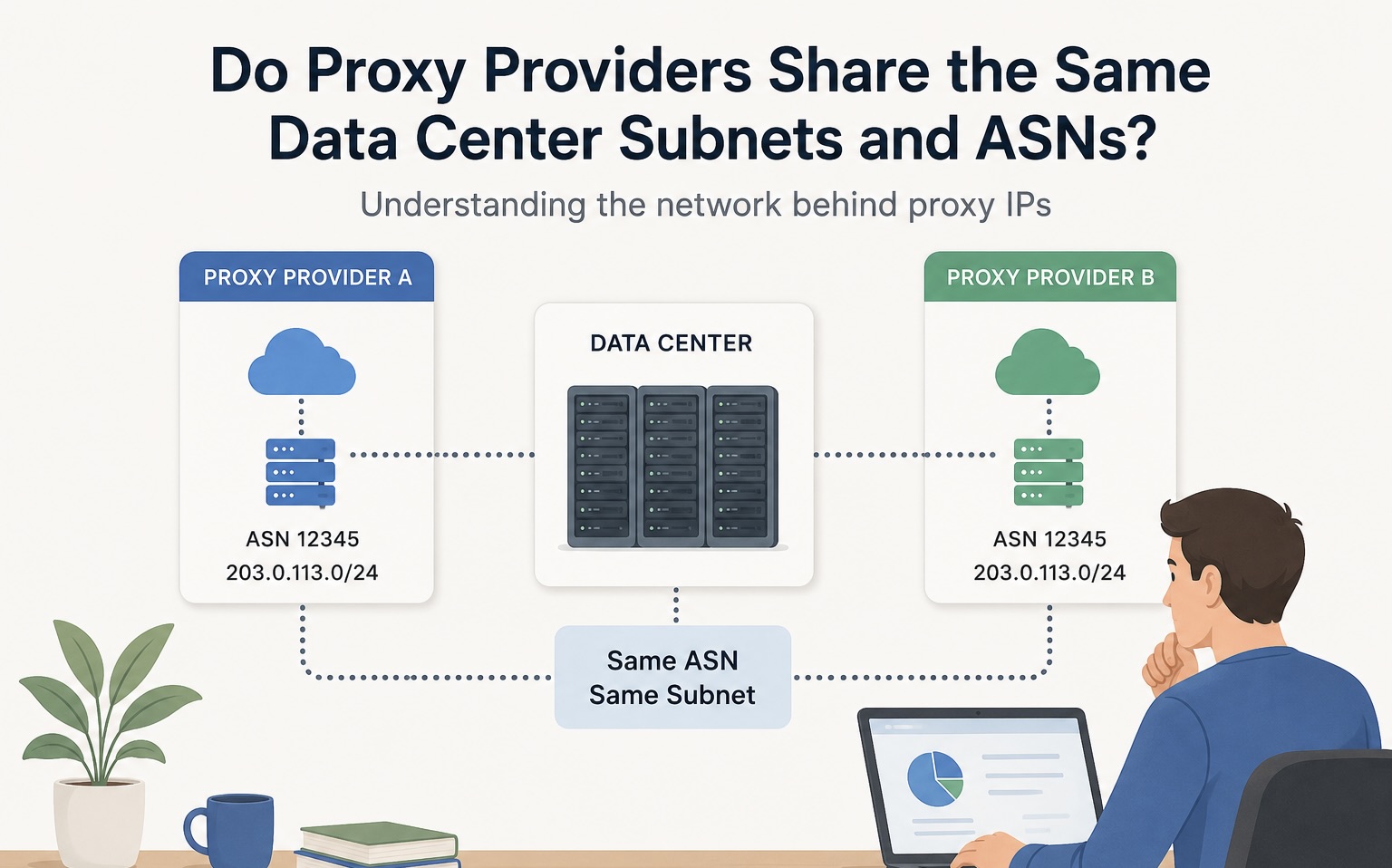
Do Proxy Providers Share the Same Data Center Subnets and ASNs? A Practical Guide to IP Infrastructure
Different proxy providers may share the same data center ASN or subnet due to shared infrastructure and limited IPv4 resources. However, shared ASN does not necessarily mean poor proxy quality. IP reputation, subnet distribution, network stability, rotation, and overall IP management are more important factors when evaluating a proxy provider.

When choosing a proxy provider, most users focus on factors such as IP count, geographic coverage, bandwidth, rotation settings, and price. However, there is another important aspect that is often overlooked: the network infrastructure behind the IPs.
Two proxy providers may advertise thousands or even millions of IP addresses, but that does not necessarily mean they operate completely independent networks. In some cases, different providers may use IPs from the same data center subnet, Autonomous System Number (ASN), hosting network, or upstream provider.
This raises an important question:
Do different proxy providers share the same data center subnets and ASNs? And if they do, does it affect proxy quality?
The short answer is: yes, providers can share the same ASN or subnet, but the impact depends on how the IP resources are sourced, managed, distributed, and used.
In this article, we will explain the relationship between proxy IPs, subnets, ASNs, and proxy providers, and discuss how these factors can affect proxy performance and reliability.
What Are a Data Center Subnet and ASN?
Before discussing shared infrastructure, it is important to understand two basic concepts.
What Is a Data Center Subnet?
A subnet is a logically grouped range of IP addresses. Data centers and hosting companies typically receive blocks of IP addresses and allocate them to servers, virtual machines, and other infrastructure.
For example, a provider may control or lease a range such as:
203.0.113.0/24
A /24 IPv4 subnet contains 256 addresses, although not all addresses are necessarily usable for customer-facing services.
When a proxy provider offers data center proxies, the proxy IPs may come from one or multiple such ranges.
What Is an ASN?
ASN stands for Autonomous System Number. It identifies an organization or network that operates a distinct routing policy on the Internet.
An ASN can belong to:
- A cloud provider
- A data center operator
- A hosting company
- An ISP
- A telecommunications company
- A large enterprise network
When you look up a proxy IP, you can often find information about its ASN and organization.
For example, multiple proxy IPs may appear different at the IP level but still belong to the same ASN. From a network perspective, those addresses may therefore have a common infrastructure origin.
Can Different Proxy Providers Share the Same ASN?
Yes.
This is relatively common in the proxy industry, especially with data center proxies.
A proxy provider does not necessarily own every IP address it sells. Depending on its business model, it may obtain IP resources through:
- IP leasing
- Data center partnerships
- Hosting providers
- IP brokers
- Infrastructure resellers
- Cloud or server providers
- Direct ownership of IP resources
As a result, two different proxy brands can potentially offer IPs originating from the same upstream network.
For example:
Provider A → Data Center X → ASN 12345
Provider B → Data Center X → ASN 12345
The two providers may have different dashboards, pricing, rotation systems, and customer support, while some of their IP infrastructure ultimately comes from the same network.
This does not automatically mean that the providers are selling the exact same IP addresses. They may simply be using different IP ranges within the same ASN.
What About Sharing the Same Subnet?
Sharing the same subnet can be more significant than simply sharing an ASN.
Imagine that several proxy services provide IPs from the following range:
198.51.100.0/24
Even if the individual IPs are different, the addresses belong to the same subnet.
From the perspective of a target website or security system, a large number of requests originating from the same subnet may create a recognizable network pattern.
This is particularly important when a proxy pool contains many addresses concentrated in a relatively small number of IP ranges.
For example:
Proxy IP | ASN | Subnet |
|---|---|---|
198.51.100.21 | ASN 12345 | 198.51.100.0/24 |
198.51.100.37 | ASN 12345 | 198.51.100.0/24 |
198.51.100.82 | ASN 12345 | 198.51.100.0/24 |
Although these are three different IP addresses, they share the same ASN and subnet.
This is why simply counting the number of IPs is not always enough when evaluating a proxy network.
Why Do Multiple Providers Use the Same Network?
There are several reasons.
1. Limited IPv4 Resources
IPv4 addresses are limited resources. Obtaining large, clean, geographically diverse IPv4 ranges can be expensive and complicated.
Because of this, providers may lease or purchase IP resources from specialized infrastructure companies instead of building an entirely independent network.
2. Data Center Partnerships
Many proxy providers work with data centers and hosting companies.
A single data center can provide infrastructure to multiple proxy businesses, meaning that different proxy providers may have IP addresses associated with the same ASN.
3. Reseller Networks
Some proxy companies operate partially or entirely through upstream suppliers.
In this model, the provider manages the customer-facing service while another company supplies some of the underlying IP resources.
This can create overlap between proxy providers.
4. Geographic Availability
In certain countries and regions, obtaining large quantities of data center IPs is more difficult.
Providers may therefore rely on a limited number of local network operators to maintain geographic coverage.
As a result, multiple proxy providers may inevitably use IPs associated with the same ASN.
Does a Shared ASN Mean the Proxy Is Bad?
Not necessarily.
ASN overlap by itself is not a reliable indicator of proxy quality.
A proxy can still perform well even if other providers use IPs from the same ASN.
What matters more is the overall quality and management of the IP pool, including:
- IP reputation
- Subnet distribution
- Historical abuse
- IP rotation
- Session stability
- Geographic accuracy
- Network latency
- Connection success rate
- Traffic patterns
- Provider-level IP management
For example, two providers can use the same ASN while maintaining very different IP pools.
Provider A may carefully monitor IP reputation and remove problematic addresses.
Provider B may repeatedly recycle heavily abused IPs.
Although both providers use the same ASN, the actual user experience can be completely different.
Therefore, ASN should be treated as one signal rather than the only quality metric.
Why IP Reputation Matters More Than IP Count
A large proxy pool does not automatically mean a high-quality proxy network.
Consider two providers:
Provider A
- 1 million IPs
- Many IPs concentrated in the same infrastructure
- Limited reputation monitoring
- High proportion of previously abused addresses
Provider B
- 300,000 IPs
- More diversified network sources
- Active IP monitoring
- Better subnet distribution
- Regular replacement of problematic IPs
For certain use cases, Provider B may deliver a much more stable experience despite having fewer total IPs.
This is especially relevant for applications where IP reputation matters, such as:
- Web data collection
- Advertising verification
- E-commerce operations
- Market research
- Search engine data collection
- Account management
- Price monitoring
The goal should not simply be to find the largest IP pool. It should be to find an IP pool that is appropriate, stable, and well managed for the intended workload.
How Can You Check Whether Proxy IPs Share an ASN?
Users can investigate the network characteristics of a proxy IP through IP intelligence and network lookup tools.
Typically, you can check:
- IP address
- ASN
- ASN organization
- Country
- ISP or network
- CIDR/subnet
- Hosting or residential classification
Suppose you test 100 proxy IPs and discover that most of them belong to only one or two ASNs.
That does not automatically mean the provider is unreliable, but it does tell you that the network may have a relatively concentrated infrastructure structure.
If your application requires greater network diversity, you may want to compare providers based on ASN distribution and subnet diversity, rather than IP count alone.
ASN Diversity vs. IP Diversity
These two concepts are often confused.
IP Diversity
IP diversity refers to how many different IP addresses are available.
A provider may have 100,000 IP addresses.
ASN Diversity
ASN diversity refers to how many different autonomous systems those IPs originate from.
For example:
Provider A
100,000 IPs → 2 ASNs
Provider B
100,000 IPs → 20 ASNs
Provider B has significantly greater ASN diversity.
However, greater ASN diversity is not automatically better for every scenario. Some applications prioritize consistent network characteristics, while others benefit from broader infrastructure diversity.
The appropriate balance depends on the use case.
How Helodata Approaches Proxy Infrastructure
At Helodata, we understand that a proxy network is more than simply a database of IP addresses.
For users running large-scale operations, the underlying network characteristics can directly affect connection stability, performance, and the overall quality of data collection.
Our proxy services are designed to provide users with flexible access to different types of IP resources, including residential, mobile, and data center proxies, depending on their operational requirements.
Instead of evaluating a proxy only by the number of available IPs, users can consider several factors together:
- Geographic coverage
- IP type
- Network quality
- IP reputation
- Session behavior
- Rotation requirements
- Connection stability
- Infrastructure distribution
For data center proxy use cases in particular, understanding ASN and subnet distribution can help users select a network that better matches their requirements.
For workloads that require more natural IP characteristics, residential or mobile proxies may also be more appropriate than relying exclusively on data center infrastructure.
When Should You Pay Attention to ASN and Subnet Distribution?
Not every proxy user needs to analyze ASN information in detail.
It becomes particularly useful when you are:
Running Large-Scale Data Collection
Large scraping operations can generate substantial request volumes. Understanding the underlying network distribution can help with infrastructure planning and troubleshooting.
Managing Multiple IPs
If hundreds or thousands of IPs are being used simultaneously, knowing whether those addresses are concentrated within a small number of subnets can provide useful insight into the proxy pool.
Experiencing Frequent Blocks
If a proxy pool consistently experiences restrictions, analyzing ASN and subnet patterns can help determine whether the problem is related to IP reputation or infrastructure concentration.
Comparing Proxy Providers
ASN and subnet information can be another useful metric when comparing providers that appear similar in terms of IP count and price.
A Better Way to Evaluate a Proxy Provider
Instead of asking only:
“How many IPs does this provider have?”
consider asking:
“Where do these IPs come from, how are they distributed, and how are they managed?”
A more comprehensive evaluation should include:
Factor | Why It Matters |
IP Count | Indicates the overall size of the pool |
ASN Distribution | Shows network-level diversity |
Subnet Distribution | Helps identify IP concentration |
IP Reputation | Affects accessibility and reliability |
Geographic Accuracy | Important for location-specific operations |
Rotation | Determines how easily IPs can be changed |
Session Stability | Important for long-running connections |
Latency | Influences request speed |
Success Rate | Reflects practical usability |
Support | Important when troubleshooting |
This approach provides a much more realistic picture of proxy quality than IP count alone.
Final Thoughts
Yes, different proxy providers can share the same data center ASN or even overlapping subnet infrastructure. This is a natural result of how IP resources are leased, allocated, and distributed across the Internet.
However, shared ASN or subnet information should not be interpreted as proof that a proxy provider is low quality.
The more important question is how the provider manages those resources.
For users evaluating proxy services, look beyond the headline IP count. Consider ASN distribution, subnet concentration, IP reputation, geographic coverage, rotation, stability, and overall network management.
Understanding these underlying factors can help you make a more informed decision and choose proxy infrastructure that matches your specific requirements.
With the right IP type and network strategy, proxy infrastructure can provide a more stable foundation for data collection, e-commerce operations, advertising verification, and other legitimate online workflows.