How to Evaluate Proxy IP Quality: A Practical Guide to Reputation, Location, and Reliability
Proxy IP quality depends on more than reputation scores. Learn how to assess IP history, network type, geographic accuracy, connection stability, and real-world performance to choose proxies that fit your business needs.

Introduction
Choosing a proxy provider is not simply a matter of comparing prices, connection speeds, or the number of available IP addresses. For businesses that rely on proxies for market research, web data collection, advertising verification, and cross-border operations, the quality of an IP address can directly affect the reliability of their workflows.
An IP address may connect successfully but still encounter frequent CAPTCHAs, restricted access, or inconsistent results on certain websites. In other cases, an IP may appear clean in a reputation database yet perform poorly in a specific application.
These differences highlight an important point: a successful connection does not necessarily mean an IP address is suitable for your business.
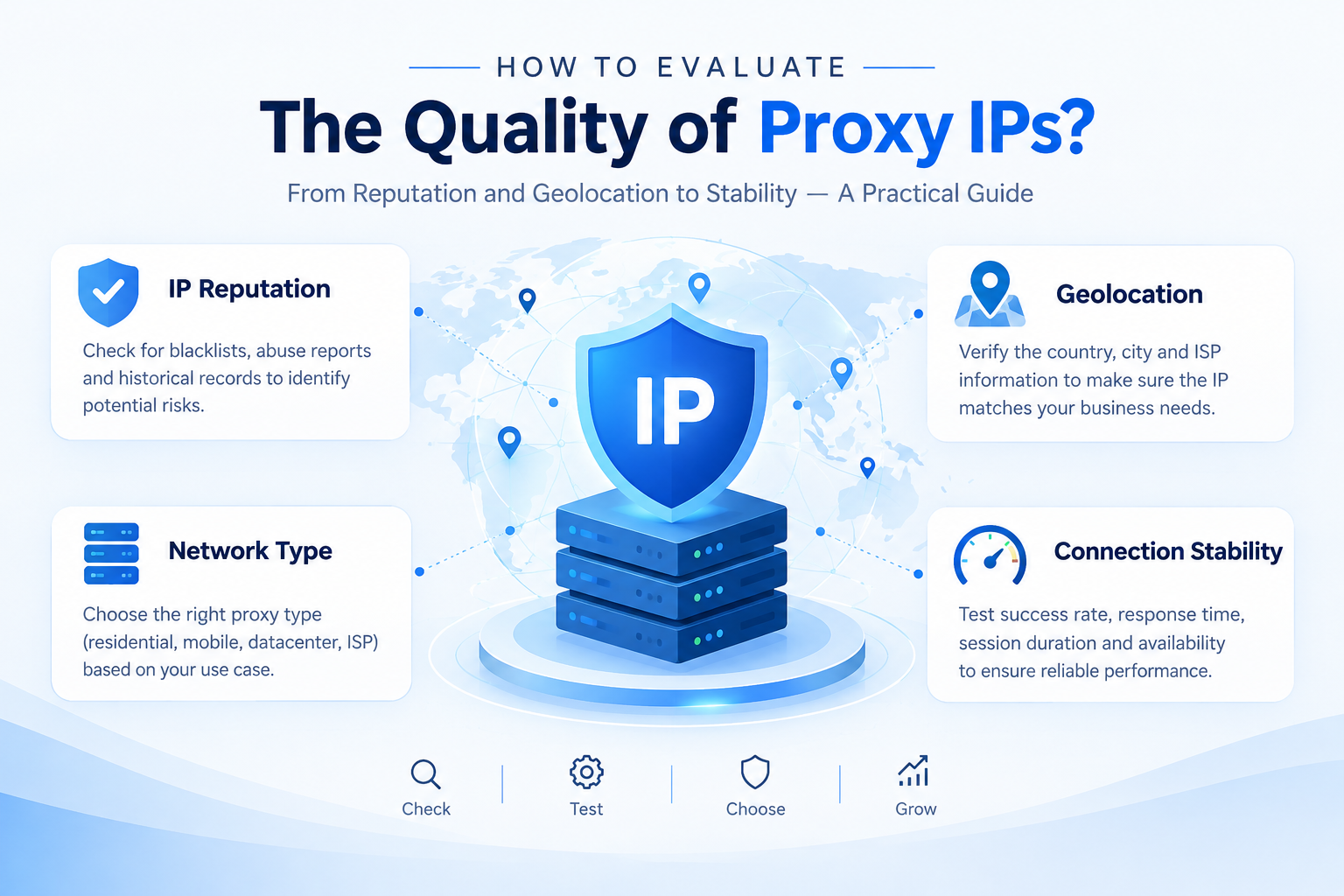
To evaluate proxy IP quality more effectively, businesses need to consider several factors, including reputation history, network classification, geographic accuracy, connection stability, and real-world performance. This guide explains how these factors work together, how to assess an IP address, and how to choose proxy resources based on your actual requirements.
1. What Determines Proxy IP Quality?
Proxy IP quality is a broad concept rather than a single technical metric. It describes how well an IP address meets the requirements of a particular application.
An IP that works well for public data collection may not be the best option for long-term account management. Similarly, an address suitable for testing localized search results may not meet the stability requirements of a continuous business workflow.
Four major factors deserve attention.
1.1 IP Reputation and Previous Usage
An IP address may accumulate a reputation over time based on how it has been used and how different websites interpret its traffic.
For example, an address associated with repeated abusive requests, spam activity, or other suspicious behavior may receive negative reputation signals from certain databases or platforms. When subsequent requests come from that address, a website may apply additional verification or access restrictions.
However, historical reputation should not be interpreted in isolation. A record in a third-party database does not automatically mean that an IP address is unusable. The age of the record, the type of reported activity, and the database's coverage all matter.
When evaluating an IP, consider:
- Whether the address appears on relevant blocklists.
- Whether abuse reports exist and how recent they are.
- Whether multiple reputation services report similar findings.
- Whether the IP performs consistently on the websites relevant to your business.
This approach provides a more useful assessment than relying on a single reputation score.
1.2 Network Type and IP Classification
Proxy IPs can originate from different types of networks, including residential networks, mobile networks, and data centers. These classifications describe the network associated with an address, but they do not independently determine its quality.
Residential proxies generally use IP addresses associated with residential internet service providers. They can be useful for location-sensitive research, localized website testing, and other workflows that benefit from residential network characteristics.
Mobile proxies use IP addresses associated with mobile networks. They may be appropriate for mobile-oriented applications, mobile network testing, and certain regional research tasks.
Data center proxies originate from hosting or data center infrastructure. They can be suitable for applications that prioritize throughput, predictable connectivity, and large-scale technical operations.
ISP proxies are commonly associated with internet service providers while being hosted on infrastructure designed for proxy services. Their exact characteristics depend on the provider and resource configuration.
No category is automatically superior in every situation. The right choice depends on the target website, expected traffic, session requirements, and budget.
It is also important to distinguish network type from IP reputation. A residential IP can still have a poor reputation, while a data center IP can perform reliably for a suitable use case.
1.3 Geographic Accuracy
Geographic information is another important part of proxy evaluation, especially for businesses operating across multiple markets.
An IP address may be associated with a particular country or city in commercial geolocation databases. However, different databases may return different locations because they use different data sources, update schedules, and classification methods.
Businesses should distinguish between two concepts:
- IP geolocation: The country, region, or city that a database associates with an IP address.
- Network operator: The organization or network identified through ASN and registration information.
These details are related, but they are not interchangeable. An IP address can be geolocated to Singapore while its network operator is associated with a company registered in another country.
This difference does not automatically indicate a problem. The relevant question is whether the IP's geographic location matches the requirements of the intended application.
For regional market research, localized search testing, or country-specific content verification, the reported location is often particularly important. If a project also requires a specific carrier or network type, that requirement should be checked separately.
1.4 Connection Stability and Session Behavior
An IP address may have a good reputation but still be unsuitable if connections frequently fail or sessions end unexpectedly.
Connection quality includes several dimensions:
- Success rate: How often requests complete successfully.
- Latency: How long it takes for requests to receive a response.
- Session consistency: Whether the IP remains the same for the required period.
- Availability: Whether the proxy can be accessed when the business needs it.
- Throughput: How much data can be transferred within a given period.
These measurements should be evaluated against the actual workload. A low-latency proxy is useful for interactive tasks, while a data collection workflow may place greater emphasis on request success rates and sustained throughput.
A proxy should therefore be evaluated as part of a complete workflow rather than by a single performance indicator.
2. How to Check Whether a Proxy IP Is Suitable
A practical evaluation process combines independent data sources with controlled testing. The goal is not to obtain a perfect score from every tool, but to identify potential problems before deploying a proxy in a production environment.
Step 1: Check IP Reputation Databases
Start with publicly available reputation and abuse-reporting services.
Examples include:
- AbuseIPDB: Provides information about reported abusive activity associated with IP addresses.
- Spamhaus: Maintains reputation and blocklist information for various types of network abuse.
- APIVoid: Offers IP reputation and threat-related lookup tools.
These services can help identify potential warning signs, but their results should be interpreted carefully.
A low number of reports does not guarantee that an IP will be accepted by every website. Likewise, a historical report does not necessarily mean the address is currently problematic.
Check the reporting dates, categories, and available supporting details instead of treating every listing as equally serious.
Step 2: Review Fraud and Proxy Detection Signals
Some services estimate whether an IP address is associated with suspicious activity or identify its likely network classification.
Tools such as Scamalytics and IPQualityScore can provide additional information about risk signals and IP attributes, depending on their available data and service features.
When reviewing the results, pay attention to:
- Whether the address is classified as residential, mobile, hosting, or another network type.
- Whether the service reports elevated risk indicators.
- Whether the result is consistent with your expected IP location and network characteristics.
- Whether different services produce substantially different assessments.
Avoid comparing numerical scores across different platforms as if they used the same scale. Each service may apply its own methodology, data sources, and thresholds.
A score should be treated as one piece of evidence, not as a universal measure of proxy quality.
Step 3: Verify Geographic and Network Information
Use an IP lookup service to examine the address's reported country, region, city, ASN, and internet service provider where available.
For example, a project that requires a Singapore IP should first verify that the IP is reported in Singapore by relevant geolocation databases.
If the carrier or ASN is also important, check those details independently. A location match does not guarantee an operator match, and an operator match does not necessarily establish an exact city-level location.
If several lookup services disagree, investigate the discrepancy before deciding whether the IP is suitable. Different databases may have different levels of geographic precision, and their records may not update simultaneously.
Step 4: Test the Proxy in Your Intended Workflow
Third-party tools provide useful information, but they cannot fully reproduce the conditions of your actual application.
Run a small, controlled test using the websites, APIs, or services that matter to your business.
Record the following information:
Metric | What to observe |
|---|---|
Connection success | Whether requests complete without connection errors |
Response time | Whether latency meets application requirements |
Access restrictions | Whether the target returns blocks, CAPTCHAs, or additional verification |
Geographic results | Whether the website displays the expected regional content |
Session behavior | Whether the IP remains stable for the required duration |
Data consistency | Whether returned content is complete and reproducible |
Where possible, use the same request parameters and similar testing conditions when comparing proxy options. Otherwise, differences in the results may come from the test itself rather than the IP.
Testing should also respect the target website's terms, access restrictions, and applicable data protection requirements.
Step 5: Monitor Performance Over Time
A single successful test only confirms that a proxy worked under particular conditions.
For ongoing business operations, monitor performance across multiple sessions and relevant time periods. Track connection failures, response times, verification frequency, and changes in geolocation or reputation information.
If performance deteriorates, investigate the cause instead of immediately assuming that the IP itself is responsible.
Possible causes include network congestion, incorrect proxy settings, authentication errors, target website changes, excessive request frequency, or account-specific restrictions.
A consistent monitoring process makes it easier to distinguish isolated incidents from recurring problems.
3. Common Mistakes When Evaluating Proxy IPs
Even experienced proxy users can make incorrect assumptions when selecting IP resources. The following mistakes are especially common.
Mistake 1: Assuming Residential IPs Are Always Clean
Residential classification describes an IP's network characteristics, not its complete reputation history.
An address can belong to a residential network and still have been used in ways that affected its reputation. Residential proxies should therefore be evaluated using the same basic principles of reputation checks and real-world testing.
Mistake 2: Relying on One Detection Website
Different detection services may return conflicting information because their databases, update schedules, and risk models differ.
Instead of selecting the most favorable result, compare multiple sources and investigate major inconsistencies. For important projects, combine external checks with actual application testing.
Mistake 3: Treating Every CAPTCHA as an IP Problem
CAPTCHAs and access restrictions can be influenced by multiple signals, including request frequency, account history, browser configuration, session behavior, and the website's own security policies.
If a proxy triggers a verification challenge, examine the entire request environment before concluding that the IP has a poor reputation.
Repeatedly changing IP addresses without identifying the underlying issue may increase costs without improving results.
Mistake 4: Ignoring Location and Network Requirements
A proxy that connects successfully may still return the wrong regional content or fail to meet a project's network requirements.
For example, geographic location and carrier identity are separate attributes. Businesses should define which attribute matters before purchasing proxy resources and verify each requirement independently.
Mistake 5: Choosing Based on Price Alone
A low-cost proxy may appear attractive initially, but frequent failures, inconsistent sessions, and additional troubleshooting can increase the total cost of a project.
A more useful comparison considers the cost of successful requests, usable data collected, or completed business tasks.
The cheapest option is not necessarily the most economical if it requires repeated retries or manual intervention.
4. Which Business Applications Benefit Most from Careful Proxy Evaluation?
Proxy quality matters differently across industries. Understanding the requirements of each application helps businesses select appropriate resources without paying for unnecessary features.
4.1 Web Data Collection and Market Research
Businesses often collect publicly available information to analyze market trends, product availability, pricing, and competitor activity.
In these workflows, connection reliability, response consistency, and suitable geographic coverage are important. Poor proxy performance can lead to failed requests, incomplete datasets, and additional processing costs.
Proxy selection should account for the target website's access policies, request volume, expected duration, and required locations.
A reliable collection workflow also needs appropriate rate limits, error handling, and data validation. Proxy quality is only one component of the overall system.
4.2 SEO Monitoring and Localized Search Research
Search results can vary by location, language, device configuration, and other contextual factors.
Businesses conducting international SEO research may use regionally appropriate proxy IPs to examine search results and website behavior from different markets.
In this case, geographic accuracy and repeatable test conditions are particularly important. Teams should record the IP location, search settings, and testing time so that results can be compared more consistently.
4.3 Advertising Verification
Advertising verification helps businesses examine whether campaigns appear in the expected regions and whether landing pages display the correct localized content.
Proxy resources can support these checks by providing network access associated with relevant markets.
However, an IP address alone cannot guarantee that an advertisement will appear. Ad delivery can also depend on campaign settings, audience criteria, device characteristics, browsing context, and platform policies.
A sound verification process accounts for these variables instead of attributing every discrepancy to proxy quality.
4.4 Cross-Border Business Operations
Companies working across multiple countries may need to access region-specific websites, test localized user experiences, or conduct market research in different regions.
For these applications, the appropriate proxy type depends on the task. Some workflows prioritize residential network characteristics, while others benefit from stable sessions, predictable connectivity, or high data throughput.
Defining requirements before choosing a proxy helps avoid unnecessary spending and reduces the risk of selecting resources that do not fit the intended use.
5. How to Choose the Right Proxy for Your Requirements
Rather than looking for a proxy that is supposedly perfect for every task, begin by defining the requirements of your project.
First, identify the target application. Determine whether you need regional website testing, public data collection, advertising verification, or another business workflow.
Second, define the required IP characteristics. Consider network type, country or city, session duration, rotation behavior, and whether a particular operator or ASN is necessary.
Third, establish measurable performance criteria. Set acceptable thresholds for connection success, latency, session stability, and data completeness.
Fourth, test before scaling. Use a limited number of proxy resources to validate the configuration and confirm that the results meet your requirements.
Finally, review performance regularly. Business needs and website policies can change, so a proxy configuration that works today may need to be reassessed later.
For teams with specialized requirements, working with a provider that offers different proxy types, geographic options, and technical support can make it easier to identify a suitable configuration.
At Helodata, businesses and developers can explore proxy options based on their project requirements. Rather than choosing solely by advertised IP volume or price, users should consider the network characteristics, location, session behavior, and expected workload that matter to their applications.
6. Frequently Asked Questions
Is a high proxy IP reputation score enough to guarantee successful access?
No. Reputation scores reflect the signals and methodology used by a particular service. Websites may use additional security checks, account information, behavioral signals, and access policies. A favorable score is useful, but it cannot guarantee successful access.
Are residential proxies always better than data center proxies?
No. Residential proxies may be appropriate when residential network characteristics or geographic coverage are important. Data center proxies can be suitable for workloads that prioritize throughput and predictable connectivity. The best choice depends on the target application and its requirements.
Why do IP detection websites show different results for the same address?
Detection services may use different data providers, update schedules, classification methods, and risk models. Geographic records and network classifications can also change over time. Comparing multiple sources helps identify inconsistencies, but differences do not automatically indicate that an IP is defective.
Why does a proxy pass IP checks but still trigger a CAPTCHA?
A website may evaluate more than the IP address. Request frequency, account history, browser settings, session characteristics, and the website's security policies can all influence whether additional verification is required. Review the full workflow before concluding that the IP is the cause.
Should I use a rotating or static proxy?
A rotating proxy changes the exit IP according to the provider's rotation rules or session configuration. A static proxy keeps the same IP for a longer period, subject to the service's availability and terms.
Rotating proxies can be useful for tasks that require access across a pool of addresses, while static proxies may be preferable when a consistent IP is needed for a particular workflow. Neither option is universally better; the choice should follow the application's session requirements.
How often should proxy IPs be checked?
There is no universal schedule. The appropriate frequency depends on the importance of the workflow, the duration of use, observed performance changes, and the cost of failure.
For ongoing projects, monitor connection metrics continuously where practical and repeat reputation or geolocation checks when performance changes or the application requires additional verification.
Conclusion
Evaluating proxy IP quality requires more than checking whether an address connects or receives a favorable reputation score. Network classification, geographic accuracy, historical reputation, session behavior, and real-world performance all contribute to determining whether a proxy is suitable for a particular task.
The most effective approach is to combine several independent checks with controlled testing and ongoing monitoring. By defining business requirements first and evaluating proxy resources against measurable criteria, companies can make more informed decisions, reduce avoidable failures, and build more reliable workflows.
The goal is not simply to find an IP that looks good on a detection website. It is to find a proxy configuration that consistently meets the requirements of your actual business.