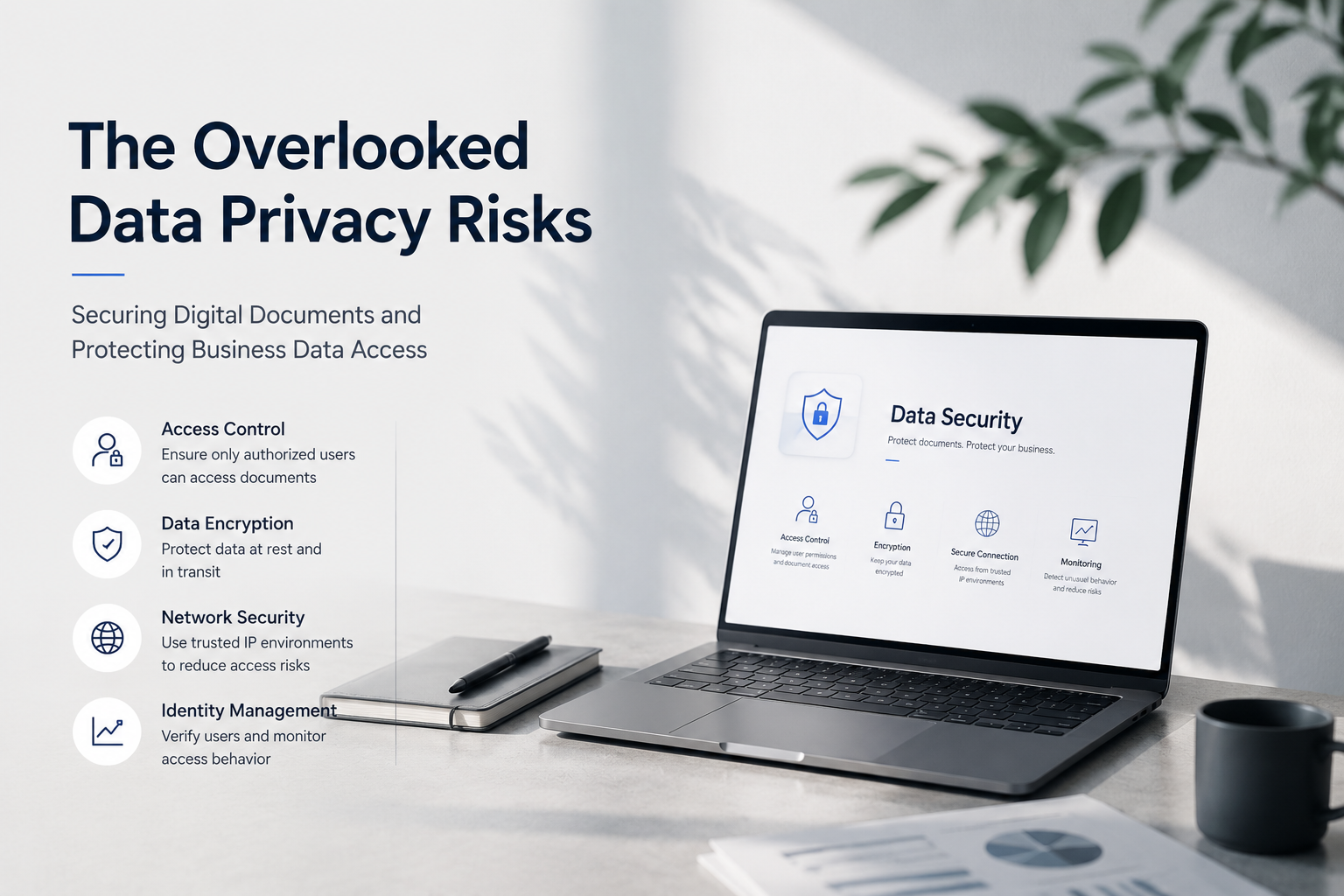
The Overlooked Data Privacy Risks: Securing Digital Documents, Access Control, and Business Data Protection
Digital document privacy risks go beyond file storage. Businesses need secure access control, encryption, and reliable network environments to protect sensitive information. Residential proxy infrastructure can help organizations build more flexible and stable global data access workflows.

Introduction
In today’s digital-first business environment, data has become one of the most valuable assets for organizations.
From customer records and financial reports to contracts, product strategies, and internal communications, digital documents are now at the center of daily business operations. Companies rely heavily on cloud platforms, SaaS applications, and remote collaboration tools to store and manage sensitive information.
However, while businesses continue investing in cybersecurity solutions such as firewalls, endpoint protection, and threat detection systems, one critical area is often overlooked:
The privacy risks involved in accessing, transferring, and managing digital documents.
Protecting data is no longer only about where information is stored. It is also about understanding:
- Who is accessing the data
- Where the access request comes from
- Whether the network environment is trustworthy
- Whether the access behavior matches normal patterns
A complete data privacy strategy requires protection throughout the entire data lifecycle.
Why Digital Document Privacy Has Become a Growing Security Challenge
The Shift From Local Storage to Cloud-Based Workflows
In the past, many businesses stored important documents on internal servers or local devices.
Today, organizations increasingly rely on:
- Cloud storage platforms
- SaaS applications
- Online collaboration tools
- Remote working environments
This transformation has improved efficiency and accessibility, but it has also created new security challenges.
More digital access points mean:
- More users interacting with sensitive data
- More devices connecting to business systems
- More third-party services involved in workflows
Every additional access point introduces potential privacy risks.
Data Breaches Are Not Always Caused by External Attacks
Many businesses associate data leaks with sophisticated cyberattacks.
However, a large number of privacy incidents are caused by internal management issues, such as:
- Incorrect file-sharing permissions
- Compromised employee accounts
- Weak authentication methods
- Unsafe network connections
- Poor third-party access management
For example, a publicly accessible document link or an employee accessing sensitive files through an unsecured network can create serious privacy concerns without any direct hacking activity.
Understanding Digital Document Security Through the Data Lifecycle
A strong privacy strategy requires businesses to manage data throughout its entire lifecycle.
The data lifecycle generally includes:
- Data Creation
- Data Storage
- Data Access
- Data Sharing
- Data Retention and Disposal
Each stage introduces different security challenges.
1. Data Creation: Protecting Information From the Beginning
When organizations create digital documents, they often collect valuable information, including:
- Customer details
- Business records
- Transaction information
- Internal strategies
At this stage, companies should follow principles such as:
Data Minimization
Only collect and store information that is necessary for business purposes.
Privacy by Design
Security considerations should be included during the creation process rather than added later.
2. Data Storage: Securing Digital Assets
Storing documents in cloud platforms or internal systems requires strong security controls.
Common risks include:
- Misconfigured cloud storage
- Excessive user permissions
- Lack of encryption
- Unauthorized access
Organizations commonly use:
Encryption at Rest
Protecting stored data in databases, servers, and cloud environments.
Access Policies
Defining who can view, edit, or manage specific documents.
3. Data Access: The Most Overlooked Privacy Layer
Many organizations focus on protecting stored information but pay less attention to how data is accessed.
Modern security systems increasingly analyze:
- User identity
- IP address
- Geographic location
- Device information
- Access frequency
- Behavioral patterns
For example:
If an employee normally accesses company documents from one region but suddenly attempts multiple downloads from an unfamiliar location, the activity may be considered suspicious.
This is why access context has become an essential part of modern data protection.
Building a Modern Data Privacy Protection Framework
1. Zero Trust Architecture
Traditional security models often follow the assumption:
Users inside the organization can be trusted.
Modern security follows a different approach:
Never trust automatically. Always verify.
This concept is known as Zero Trust Architecture.
Its main principles include:
- Verify every access request
- Apply least privilege access
- Continuously monitor activity
- Assume potential compromise
Zero Trust helps organizations reduce risks caused by stolen credentials or unauthorized access.
2. Identity and Access Management (IAM)
Identity management is a fundamental component of digital privacy protection.
Common IAM technologies include:
Multi-Factor Authentication (MFA)
Requires users to verify their identity through multiple methods.
Role-Based Access Control (RBAC)
Allows organizations to assign permissions based on job responsibilities.
Single Sign-On (SSO)
Provides centralized authentication across multiple applications.
Together, these technologies help businesses control who can access sensitive documents.
3. Managing Network Access Environments
Identity alone is not enough.
The network environment behind an access request also plays an important role.
Security systems often evaluate:
- IP address reputation
- Geographic consistency
- Network provider information
- Request patterns
An unusual IP address or unexpected location change may trigger additional verification.
This means IP addresses are no longer just connection tools — they are also part of digital identity analysis.
Why IP Reputation Matters in Data Privacy
Many organizations underestimate the role of IP environments in secure data access.
Security systems frequently use IP-related signals to evaluate whether an access request appears legitimate.
Different IP types can create different access patterns.
Data Center IPs
Advantages:
- High speed
- Cost efficiency
However, some platforms may classify large-scale activity from data center networks as higher-risk due to automation patterns.
Residential IPs
Residential IPs originate from real household internet connections.
They provide:
- More natural browsing environments
- Better geographic accuracy
- More realistic user access patterns
This makes residential proxies useful for businesses that require regional data validation and reliable online access.
How Residential Proxies Support Better Global Data Workflows
For global companies, accessing online information across different regions is often necessary.
Common use cases include:
- Market research
- Website verification
- Advertising validation
- Regional content testing
- Public data analysis
Residential proxies can help businesses create more accurate access environments.
1. More Accurate Regional Data Verification
Websites often display different content depending on visitor location.
Businesses may need to check:
- Local pricing
- Regional product availability
- Language differences
- Advertising variations
Residential proxies allow companies to access online resources from different geographic perspectives.
2. More Stable Data Collection Processes
Large-scale data workflows may encounter:
- IP restrictions
- Geographic limitations
- Access interruptions
Reliable residential IP infrastructure helps businesses maintain more consistent workflows.
3. Supporting Security Testing and Business Monitoring
Companies can use residential proxy networks to evaluate:
- Website accessibility
- Regional user experience
- CDN performance
- Online availability
This provides valuable insights for global operations.
Helodata: Building Reliable Data Access Infrastructure
As businesses become increasingly dependent on digital information, reliable access infrastructure has become an important part of modern operations.
Helodata provides global residential proxy solutions designed to support:
- Market research
- Data analysis
- Business intelligence
- Regional content verification
- Global online workflows
With:
- Global residential IP coverage
- Reliable connections
- Flexible location options
- Stable access environments
Helodata helps businesses build more efficient and consistent data workflows.
Data protection is not only about securing information after it is collected.
It is also about creating a reliable and controlled environment for accessing digital resources.
Future Trends in Data Privacy
1. AI-Driven Data Access
As AI agents become more common, automated systems will access and process larger amounts of information.
Managing secure AI-driven data access will become a major challenge for businesses.
2. Stricter Privacy Regulations
Regulations such as GDPR and other privacy frameworks continue pushing organizations toward:
- Better transparency
- Stronger access controls
- Improved data governance
3. Digital Identity and Network Intelligence
Future security systems will increasingly combine:
- User identity
- Device information
- IP reputation
- Behavioral analysis
to determine whether access requests are trustworthy.
Conclusion
Digital document security is no longer simply a file storage problem.
Modern businesses need to consider multiple layers of protection, including:
- Data lifecycle management
- Identity verification
- Access control
- Network environments
- User behavior analysis
A complete privacy strategy requires both strong security practices and reliable digital infrastructure.
By combining effective data protection methods with trusted network solutions, businesses can better protect their digital assets while supporting global growth.